
From Mine to Mind: Reimagining Odisha as India’s Next Innovation Economy
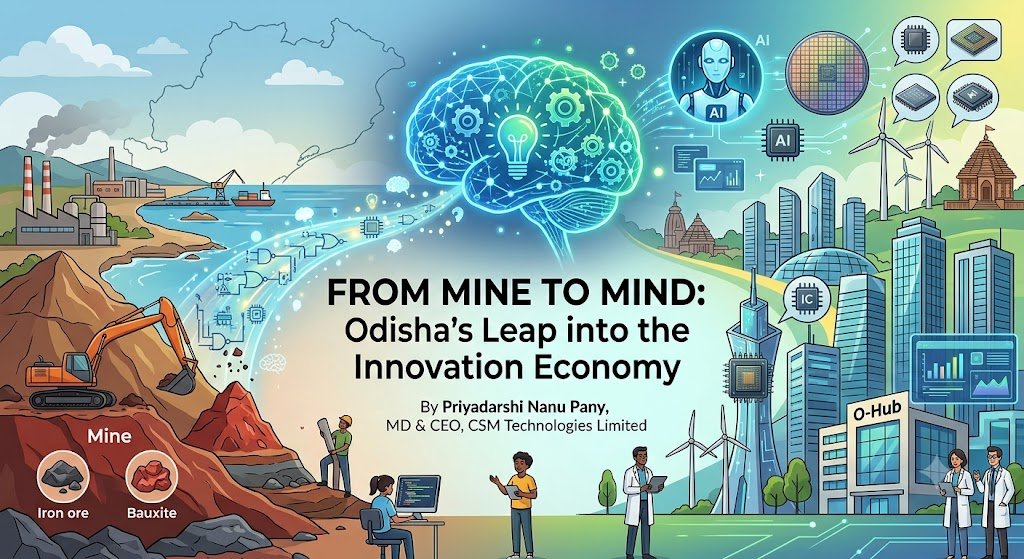
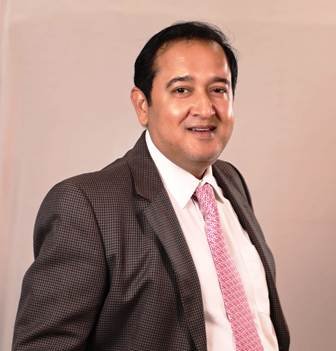
By Priyadarshi Nanu Pany, Managing Director & CEO, CSM Technologies Limited
For long, Odisha’s story was written in the language of extraction. Its mountains yielded iron ore, its soil offered bauxite, its coastline enabled industry, and its economy grew on the strength of what lay beneath the earth. Today, however, the state stands at a compelling crossroads. The most important resource Odisha seeks to mine is no longer buried in Keonjhar or Sundargarh. It sits between human ears.
This is perhaps the most consequential shift in Odisha’s economic history: the transition from a mining economy to a thinking economy, from a state known for minerals to one recognized for minds.
The phrase “Mine to Mind” is not merely a catchy slogan. It signals a profound change in economic philosophy. For years, Odisha supplied raw materials to fuel growth elsewhere. The state generated wealth but often watched value addition, intellectual property and high-paying jobs migrate to distant metropolitan skylines. The new ambition seeks to reverse that equation. Instead of exporting rocks and importing prosperity, Odisha wants to create prosperity where the rocks are.
The timing could not be better.
Around the world, economic power is increasingly determined not by ownership of natural resources but by control over technology, innovation and data. Saudi Arabia is investing oil wealth into futuristic cities. The United Arab Emirates is building AI ecosystems beyond hydrocarbons. In a similar way, Odisha appears to be betting that the smartest use of mineral wealth is to create a post-mineral economy.
The emerging semiconductor ecosystem offers an intriguing example. The proposed $3.3 billion Intel-3DGS investment and related semiconductor infrastructure initiatives could place Odisha on India’s technology map in ways that would have seemed unimaginable a decade ago. The significance extends beyond the factory floor. Semiconductor plants are not merely manufacturing facilities; they are magnets that attract research institutions, component suppliers, design centres, startups and skilled talent. One chip factory often creates an entire economic constellation around it.
Similarly, the proposed Sovereign AI ecosystem, digital infrastructure expansion and creation of Odia-language datasets reveal a deeper understanding of the future. Artificial Intelligence does not merely require machines; it requires relevance. By ensuring that AI understands local language and context, Odisha is attempting something many governments overlook: technological progress that speaks the language of the people rather than expecting citizens to speak the language of technology.
Yet ambition alone is never enough.
History offers a warning. Across India, grand investment announcements often generate headlines long before they generate jobs. Memorandum of Understanding (MoUs) are easy to sign; innovation ecosystems are notoriously difficult to build. Silicon Valley was not created through infrastructure alone. It emerged through an intricate blend of universities, venture capital, risk-taking culture, talent mobility and institutional trust.
This is where Odisha’s real test begins.
The state has demonstrated remarkable success in attracting heavy industry. Building a culture of innovation requires a different toolkit altogether. Startup ecosystems cannot be manufactured the way steel plants are. They thrive on experimentation, tolerate failure and reward unconventional thinking. Governments can build incubators like O-Hub, but they cannot decree innovation into existence.
A deeper challenge lies in human capital. Odisha can build AI parks and semiconductor corridors, but who will fill them? Unless educational institutions rapidly modernize curricula and produce industry-ready talent, companies may simply import skilled professionals from elsewhere. The danger then is creating islands of technology surrounded by oceans of unemployability.
Another concern is geographic concentration. Most innovation-driven investments naturally gravitate towards Bhubaneswar and its adjoining regions. If the benefits of the new economy remain confined to a few urban centres, the “Mine to Mind” transition risks creating a new inequality gap. The future of Odisha will depend on whether a student in Koraput, a startup founder in Sambalpur and a young coder in Berhampur can participate in the innovation economy as easily as someone in the capital city.
Nevertheless, there is reason for optimism.
Odisha’s transformation is not being built solely on incoming investments but also on the growing strength of its own enterprises. Homegrown companies across technology, manufacturing and services have demonstrated that globally relevant businesses can emerge from the state and scale beyond it. The IT sector in particular has shown that innovation can be engineered from Bhubaneswar as effectively as from India’s traditional technology hubs. Companies born and built in Odisha, have expanded across sectors and geographies, serving governments and enterprises in multiple countries while creating high-value employment locally. Their success sends an important signal to investors and entrepreneurs alike: Odisha is no longer just a market or talent source; it is increasingly a creator of technology, solutions and intellectual capital.
Equally important is the question of equity. Sustainable innovation economies are not created by a few large projects alone but by enabling thousands of entrepreneurs to participate in growth. With nearly 2,800 recognised startups across sectors including IT, AI, healthcare and Agritech, supported through incubators, startup policies and innovation platforms, Odisha is gradually building a broader base for value creation. The real opportunity lies in helping local enterprises evolve from regional success stories into national and global champions, ensuring that wealth, skills and opportunity remain distributed across the state rather than concentrated in a handful of urban enclaves.
Odisha possesses advantages that many competing states would envy: political stability, strong fiscal management, industrial experience, abundant renewable energy potential, improving infrastructure and a youthful population. More importantly, it has clarity of direction. Vision 2036 and 2047 demonstrate an understanding that the next phase of development must be driven by knowledge, technology and value creation rather than resource extraction alone.
The ultimate success of this transformation will not be measured by the number of investment summits held or MoUs signed. It will be measured by whether the child of a miner can become a chip designer, whether a local entrepreneur can build a global technology company from Bhubaneswar, and whether Odisha can convert natural wealth into intellectual wealth.
The state has spent generations digging into the earth. The next generation may determine its destiny by digging into ideas. If that happens, Odisha’s most valuable export will no longer be ore shipped from its ports. It will be innovation shipped from its minds. That would not merely transform Odisha. It would redefine the meaning of development in India itself.