

The body without the person: AI, fashion and the rights nobody thought to protect

By Tapesh Raghav
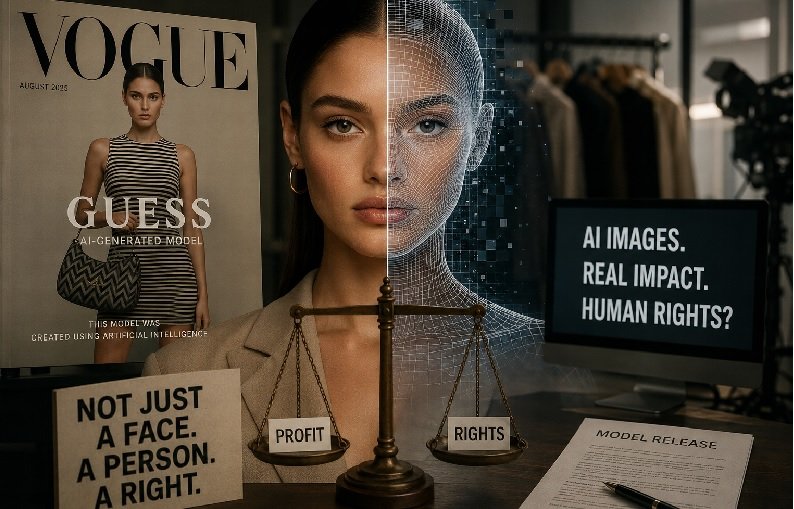
The August 2025 issue of American Vogue carried a fashion advertisement that appeared perfectly ordinary: a woman in a striped dress smiling with a branded handbag in hand. However, in fine print, the advertisement disclosed that the model was completely artificial. Created by the London-based company Seraphinne Vallora for Guess, the campaign featured two AI-generated models that looked remarkably lifelike. Although a note identified them as AI creations, most readers could easily have missed it. The public backlash was immediate. Yet while the controversy erupted quickly, the legal and economic questions it exposed have taken far longer to emerge—and even longer to be addressed.
There are two principal ways AI is now being used in fashion imagery. One is to create an entirely synthetic model—a digital person who never existed. The other is to take a real model’s face or likeness and use AI to generate new images without conducting another photoshoot. H&M, for instance, created AI “twins” of real models to speed up campaigns and manage image rights. Zalando has stated that 70 per cent of its 2024 editorial images were AI-generated while continuing to use traditional catalogues. This is not a minor technological adjustment. It represents a fundamental shift in how the fashion industry produces visual content.
The reason for this transformation is straightforward. AI platforms such as Botika claim they can reduce visual production costs by as much as 90 per cent while bringing products to market three times faster. However, the financial benefits are not being distributed equally. Models are bearing the greatest burden, while the ripple effects extend across the entire creative workforce. Every lost photography assignment can affect as many as ten workers, including assistants, stylists, retouchers and set designers. Even H&M’s Chief Creative Officer has acknowledged uncertainty about how the company’s shift to AI-generated imagery will affect the professionals who have long supported fashion photography. That admission is revealing. The disruption is unfolding faster than its consequences are being fully understood.
The impact is particularly severe for models who lack established reputations. Mid-career professionals who depend on routine commercial photoshoots for their livelihood are the first to be replaced because these assignments are precisely the type of work AI can now produce cheaply and efficiently. Models are generally treated as independent workers rather than employees, preventing them from unionising or negotiating collectively. As a result, they are left to face sweeping technological changes on their own. AI did not create this structural vulnerability, but it has given companies an unprecedented opportunity to exploit it.
From a legal perspective, these two forms of AI usage raise distinct concerns. The use of fully synthetic models primarily affects consumer protection and advertising disclosure laws. Consumers naturally assume that fashion images depict real human beings. When that assumption is quietly overturned through a barely noticeable disclaimer, the issue extends beyond ethics and enters the realm of potential misrepresentation in advertising. Public reactions to the Vogue–Guess controversy included calls for boycotts and subscription cancellations, reflecting a feeling of having been deceived rather than merely surprised.
The second practice—repurposing a real person’s likeness through AI-generated content—raises even more significant legal questions concerning personality rights and informed consent. A model who signs a release for a single photoshoot cannot reasonably be considered to have consented to the perpetual, scalable and transformative use of her face across countless AI-generated images. Research conducted by Cornell University’s ILR School found that agencies, brands and AI startups are increasingly treating models as “data” to be extracted for commercial gain, exploiting longstanding grey areas within the industry that leave models with little legal recourse. Model Francheska Pujols has refiled a lawsuit in a New York state court alleging that a retailer used AI-generated images of her likeness in advertisements without authorisation and beyond the scope of her contractual agreement.
India currently lacks a legal framework capable of addressing these issues. The Information Technology Act, 2000, and the Digital Personal Data Protection Act, 2023, deal broadly with data protection and privacy but say nothing about AI-generated likenesses used in commercial contexts. The right of publicity—the right of an individual to control the commercial use of their identity—remains underdeveloped in Indian law and relies largely on tort principles and the doctrine of passing off. There is no statutory requirement for informed consent, no mandatory disclosure obligation, and no sector-specific legal remedy for models whose likenesses are incorporated into AI systems and commercialised without their knowledge. As Indian fashion brands and international companies operating in India increasingly adopt AI-generated modelling, this legal vacuum will become increasingly difficult to sustain.
Looking ahead, AI is unlikely to eliminate human modelling altogether. Instead, it will probably confine human models to a premium segment of the industry. AI is poised to dominate high-volume content such as catalogue photography, e-commerce listings and social media imagery, while editorial campaigns and premium advertisements—where genuine human presence conveys qualities that algorithms cannot fully replicate—will remain the domain of established, high-profile models. The middle tier of the profession, which currently supports the majority of working models, is likely to shrink dramatically, concentrating earnings and opportunities among an increasingly small elite.
The legal framework that the fashion industry now requires must anticipate this future rather than merely respond to the present. Consent should be specific, fairly compensated and revocable. Disclosure of AI-generated imagery should be mandatory and clearly visible, rather than hidden in fine print. Most importantly, the broader creative ecosystem—including photographers, stylists, assistants, retouchers and other behind-the-scenes professionals, who face the greatest risk of displacement while possessing the least bargaining power—must be brought within the protection of an appropriate regulatory framework.
Fashion has always reflected the culture that surrounds it. What AI now offers is the illusion of a person without any of the rights that belong to a real one. The law must soon decide what price society is willing to pay for that illusion.
This version is formatted for newspaper, magazine, or journal publication, with logical paragraph breaks and minor grammatical refinements while preserving the author’s arguments and style.