

Neglected Legacy of the Paika Warriors: Khordha’s Forgotten Memorial Raises Questions Over the State’s Commitment to History.
By Dillip Kumar Pattnaik
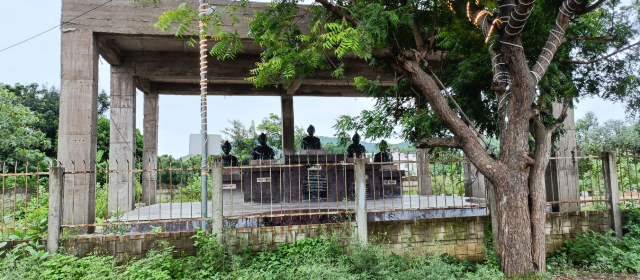
Khordha, July 29: “A nation that fails to honour its history can never build a glorious future.” These words find a painful reflection in the present condition of the Pancha Paika Memorial at Gada Khordha, where the statues of Odisha’s legendary warrior heroes now stand surrounded by neglect, wild vegetation and unfinished infrastructure. Once envisioned as a proud symbol of the Paika Rebellion—the earliest organised armed resistance against British colonial rule—the memorial today has become a stark reminder of administrative indifference towards one of India’s most significant chapters of freedom struggle.
Situated near Gada Khordha Chhak under Ward No-4 of Khordha Municipality, the memorial houses statues of the five legendary Paika warriors whose courage inspired generations of patriots. Instead of receiving the dignity and preservation befitting their historic sacrifice, the site now presents an image of abandonment. The incomplete protective roof, overgrown grass, scattered waste, inadequate lighting and lack of regular maintenance have transformed what should have been a centre of historical pride into a neglected public space.
The Paika Rebellion of 1817 occupies a unique place in India’s struggle for independence. Long before the Revolt of 1857, the Paikas of Odisha rose in arms against British rule, protesting colonial exploitation, unfair taxation and the erosion of traditional rights. Led by the legendary Bakshi Jagabandhu Bidyadhar Mohapatra, and inspired by earlier patriots such as Jayee Rajguru, the movement symbolised courage, sacrifice and unwavering commitment to freedom. Warriors including Pindiki Bahubalendra, Madhab Chandra Rautray and Krutibas Patsahani became enduring icons of resistance whose legacy continues to inspire generations of Recognising their contribution, statues of the Pancha Paika were relocated from their earlier location during the National Highway expansion project and installed at Gada Khordha with the promise of developing the area into a modern heritage memorial.
The vision was ambitious. Authorities had announced plans to create an attractive historical landmark where visitors, students and tourists could learn about Odisha’s glorious role in India’s freedom movement. Local residents had hoped the site would become a living classroom of history and an important tourist destination.
However, those aspirations now appear to have faded.
During the financial year 2025-26, construction of a protective roof over the statues was taken up with an allocation of approximately ₹6 lakh from the Member of Parliament Local Area Development fund. The project began with much publicity, but work soon came to an abrupt halt. Officials reportedly cited shortage of funds, leaving the structure incomplete. The half-finished roof now stands as a visible symbol of bureaucratic delay and lack of accountability.
With the monsoon rains lashing the region and the scorching summer heat taking their toll, conservation experts fear that prolonged exposure to natural elements may gradually damage the statues. The incomplete shelter offers little protection, raising concerns about long-term preservation of the memorial.
Equally alarming is the condition of the surrounding premises. Although an iron grill encloses the statues, the enclosure itself has been overtaken by tall weeds, wild shrubs and accumulated litter. In several places, dense vegetation has grown so high that the lower portions of the statues are barely visible. Broken landscaping, absence of routine cleaning and poor maintenance have further diminished the site’s appearance.As dusk falls, the memorial slips into darkness due to the absence of proper illumination. Residents say the area lacks adequate lighting, making the site appear deserted after sunset. The absence of security measures has also raised fears of vandalism and further deterioration.The
neglect has triggered widespread disappointment among local citizens, historians and social activists. According to residents, the memorial receives attention only on ceremonial occasions such as Independence Day, Republic Day and Odisha Divas, when political leaders and officials arrive to offer floral tributes and pose for photographs before leaving. For the remaining days of the year, they allege, the memorial remains forgotten.Many believe that symbolic observances cannot substitute genuine preservation of historical heritage.
“The statues are cleaned only before official functions. Once the programmes are over, nobody comes back to inspect or maintain the place,” remarked a local resident, expressing frustration over what many describe as tokenism rather than sincere respect for the freedom fighters.
Historians argue that the growing national recognition of the Paika Rebellion makes the present neglect even more disturbing. Over the years, scholars have increasingly acknowledged the uprising as one of India’s earliest organised armed struggles against British rule. Both the Central and Odisha governments have undertaken initiatives to highlight the historical significance of the movement through commemorative events, museums and cultural programmes.
Yet, the deteriorating condition of one of its important memorials presents a contradictory picture on the ground.
Experts believe the memorial possesses immense potential as a heritage tourism destination. With thoughtful planning, they say, the site could become an educational and cultural landmark attracting students, researchers and visitors from across the country.They suggest that the premises should be developed with landscaped gardens, pathways, seating arrangements, decorative lighting, CCTV surveillance and regular maintenance. Installation of bilingual information panels narrating the history of the Paika Rebellion and biographies of the five warrior heroes would help educate younger generations. Digital interactive displays and QR-code-based information systems could further enhance visitors’ understanding of Odisha’s contribution to India’s freedom movement.
Such initiatives, historians argue, would not only preserve the physical memorial but also strengthen public awareness of the sacrifices made by the Paika warriors.
Attempts were made to obtain the response of the Executive Officer of Khordha Municipality regarding the incomplete construction and future maintenance plans. However, despite repeated telephone calls, no response could be obtained till the filing of this report. Consequently, there remains no official clarification regarding when the unfinished roof will be completed or whether any long-term conservation plan has been prepared.The absence of an official response has further intensified public concern, with many questioning whether adequate priority is being given to preserving sites of historical importance.
Intellectuals, heritage enthusiasts and members of civil society have now appealed to the district administration and Khordha Municipality to take immediate corrective measures. They have demanded completion of the protective roof, systematic beautification of the premises, regular cleaning, proper illumination, installation of CCTV cameras, deployment of maintenance staff and creation of an informative heritage zone explaining the significance of the Paika Rebellion.
Many have also urged the authorities to integrate the memorial into Odisha’s heritage tourism circuit, ensuring that future generations remain connected to the sacrifices of the Paika warriors.The Pancha Paika Memorial represents far more than a collection of statues.
It stands as a symbol of Odisha’s indomitable spirit and its invaluable contribution to India’s freedom movement. Allowing such a monument to decay, observers say, is not merely an administrative lapse but a collective failure to honour the memory of those who laid down their lives in defence of their motherland.As public voices demanding restoration continue to grow louder, citizens now await meaningful action rather than ceremonial promises.
For many in Khordha, restoring dignity to the Pancha Paika Memorial is not simply about preserving stone statues—it is about safeguarding the living legacy of courage, sacrifice and patriotism that helped shape the history of modern India.