

India can lead the AI revolution: Prof. Sitharam
By Swagatika Mohapatra
Bhubaneswar, Nov. 21: Amidst the continuing buzz over Artificial Intelligence (AI) invading almost every sphere of life, an eminent academic has said the imminent entry of Physical AI is poised to revolutionize the age of thinking machines.
“The first wave of AI lived on screens. It worked with words, pictures and numbers. Physical AI steps off the screen and into the real world. It is AI with hands, wheels and wings. It sees, senses, moves and acts on physical things,” Prof. T.G.Sitharam, former Chairman of the All India Council for Technical Education (AICTE), said here on Saturday.
Today AI writes code, drafts legal arguments, reads X-rays and MRI scans, designs new molecules for medicines, answers questions in every Indian language and completes tasks on its own, but the next wave of Physical AI can catapult India into a position to lead this revolution, Prof. Sitharam said while delivering the 7th Convocation address at the Siksha ‘O’ Anusandhan Deemed to be University here.
Addressing recipients of Ph.D degrees, gold medal winners, students, researchers and faculty members, he said for decades the digital revolution transformed bits, but Physical AI would transform roads, factories, farms, hospitals and homes.
“Think of a surgical robot that steadies a surgeon’s hand in an operating theatre, a drone that tells a farmer exactly which corner of his field needs water, a robot that inspects a bridge, a dam or a tunnel before a crack becomes a catastrophe or a smart grid that balances solar power across a state,” Prof. Sitharam said.
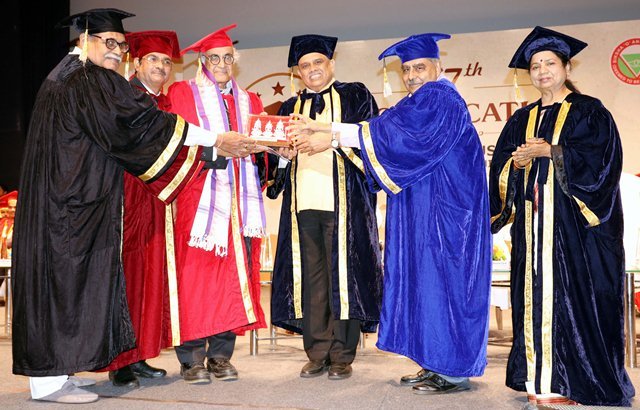
SOA’s Chancellor Prof. Amit Banerjee presided over the convocation during which 224 scholars received their doctorate degrees and 266 others were presented gold medals. Prof. Pradipta Kumar Nanda, Vice-Chancellor of SOA, presented the report.
Prof. Vasudevan Lakshminarayanan, internationally acclaimed physicist and researcher from the University of Waterloo, Canada, was conferred with Honoris Causa Doctor of Science (D.Sc.) by the university on the occasion.
“For centuries, education meant storing knowledge in the mind. Today, any fact is a few seconds away and an AI can summarize a library in minutes. So the value of education is shifting from what you know to what you can do with what you know,” Prof. Sitharam, also Advisor of IIT Khragpur, told the students and researchers adding the need was to ask the right question, judge the answer, connect ideas across fields and act responsibly.
Stating that the framers of the National Education Policy 2020 had visualized this scenario early, Prof. Sitharam said they had called for multidisciplinary learning, flexible pathways, skills alongside degrees and learning in one’s own language.
Prof. Sitharam said India today figured among the world’s top three producers of scientific publications. In the Global Innovation Index, 2026, India was ranked 38th among 139 economies, up from the 81st position it held in 2015, and was ranked first among lower middle income countries.
The walls between engineering and medicine, law and technology, agriculture and data science have been falling, he said adding this development excited him.
Prof. Sitharam said for decades the digital revolution transformed bits. Now, with the advent of Physical AI, India, with its vast manufacturing ambition, its millions of farmers, its huge infrastructural needs and its young talent, can lead this revolution, not merely consume it, he said.
Addressing the recipients of doctoral degrees, he said “your degree is not a finishing line. It is a licence to keep learning. The most important skill you take from this campus is the ability to learn, unlearn and relearn for the rest of your life,” Prof. Sitharam said.
“Use AI as a tool, never as your conscience. A machine can give you a thousand answers, but you need to decide which one is right, fair and kind. The need is to stay deeply human. Empathy, ethics, courage, creativity and the ability to care for another person are not weaknesses that technology will fix. They are qualities that will make you irreplaceable,” he said adding the need was to stay humble and pursue excellence in action.
There was also a need to invest more in research, he said.
Physical AI, he said, would need engineers who understand soil and steel, doctors who understand patients, farmers who understand the earth and lawyers who understand society. “Keep your hands in the real world”, he advised.
Striking an identical note, the SOA Chancellor Prof. Banerjee said there were two ways to fail in the age of AI. The first is to ignore it. The second, because it feels so comfortable, is to succumb to it which is more dangerous, he said.
“To let AI read for you, write for you and, slowly, think for you, will cause your own mind to fall silent one day,” he said.
But the way to supercede it was to learn it well and use it boldly before rising above it, Prof. Banerjee said.
The Chancellor urged the students to ask better questions, dare to be original, guard the truth and use AI as a tool and never as a crutch. “Climate change, health, poverty and inequality are human problems as much as technical ones. No algorithm can replace our appreciation of dignity, suffering and hope. Skill without wisdom is dangerous and intelligence without compassion is insufficient,” he said.
The Vice Chancellor Prof. Nanda said SOA’s vision was to be counted among the leading socially inclusive institutions of higher learning and prepare the future generations through quality teaching and innovative research. The university had been ranked 15th in the country by the National Institutional Ranking Framework (NIRF) in 2025, he said adding it had always been ranked among the top 25 institutions of higher learning ever since the NIRF ranking process started.
The university was focused on quality research and had established 18 research centres which were engaged in 27 identified thrust areas aligned with national priorities including Nano Science and Nano Technology, Clean Energy Systems, Cyber Security, Artificial Intelligence, Data Sciences, Quantum Science and Technology, Deep Learning, Bio-Prospecting in Medicinal Plants, Molecular Cloning, Characterisation of Novel Genes and Smart Agriculture, he said.
The convocation was attended by the Pro-Vice Chancellor cum Registrar Prof. Bibhuti Bhushan Pradhan, Controller of Examination Prof. Manjula Das, other Pro-Vice Chancellors, Deans of different institutions, Directors, faculty members and other officials.