

India enters the global rate-tightening wave differently

By Satyabrata Panda
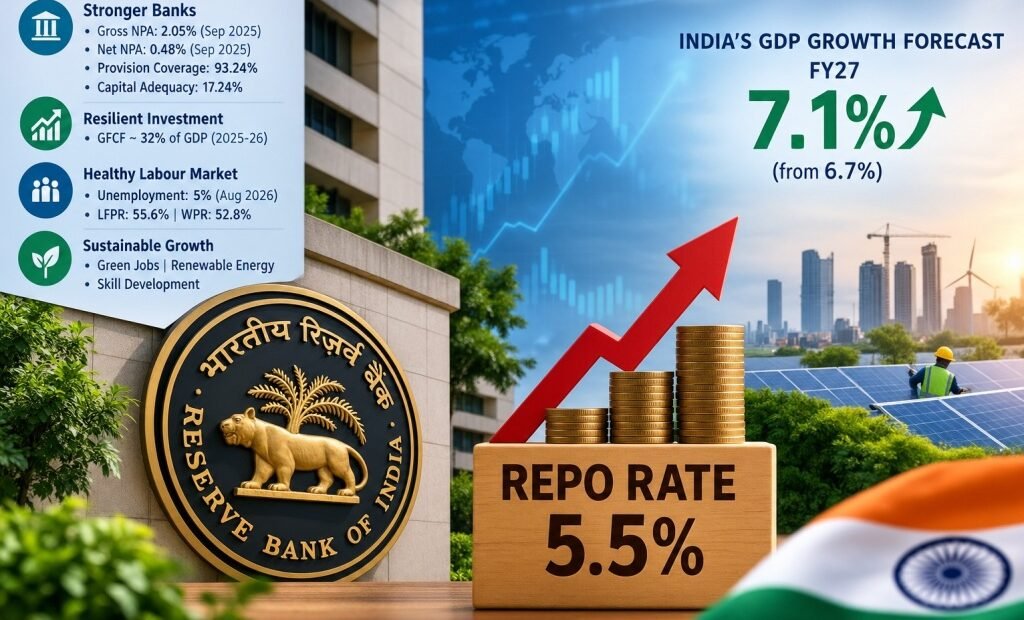
The Reserve Bank of India has joined the global rate-tightening wave, but India enters it from a rather different shore. On October 7, the Monetary Policy Committee raised the repo rate by 25 basis points to 5.5 per cent, its first increase since February 2023, and shifted its stance from “neutral” to “calibrated tightening.” The immediate reasons are familiar across the world: renewed inflationary pressure, elevated energy prices and an uncertain global environment. Yet what makes the decision unusual is the economy against which this tightening is taking place. The RBI has raised rates while simultaneously raising its 2026-27 real GDP growth forecast from 6.7 to 7.1 per cent, after growth of 7.8 per cent in the first quarter. Governor Sanjay Malhotra has described “calibrated tightening” as a milder, data-dependent rather than predetermined form of tightening. India is therefore not tightening because growth has collapsed or financial instability has forced the central bank’s hand; it is acting pre-emptively while the economy retains considerable momentum.
The numbers behind that resilience are significant. Gross fixed capital formation remained around 32 per cent of GDP in 2025-26, showing that investment did not collapse under the weight of the earlier tightening cycle. The labour market, too, has avoided the conventional disinflationary shock: unemployment among persons aged 15 and above stood at 5 per cent in August 2026, while the worker-population ratio increased to 52.8 per cent, its highest since March, and labour-force participation reached 55.6 per cent. Female labour-force participation rose from 33.7 per cent a year earlier to 34.8 per cent. These figures should not be mistaken for evidence that monetary tightening created jobs; they demonstrate something subtler and more important—that India has been able to pursue disinflation without purchasing price stability through a severe employment contraction.
Most striking is the transformation of the banking system. Scheduled commercial banks’ gross NPA ratio, which reached 11.18 per cent in March 2018, had fallen to 2.05 per cent by September 2025. Net NPAs fell even more dramatically, from 5.94 per cent to 0.48 per cent, while the provision coverage ratio rose from 62.96 per cent to 93.24 per cent and capital adequacy strengthened from 13.85 per cent to 17.24 per cent. These numbers quantify why the RBI possesses considerably greater room for monetary manoeuvre today. A central bank operating alongside fragile banks and overleveraged companies cannot easily tighten without aggravating financial stress, while rate cuts themselves may have limited effect if damaged banks are unwilling to lend. Healthier balance sheets enlarge monetary-policy space.
This is where comparison with the post-Lehman period becomes instructive. When Lehman Brothers collapsed in September 2008, central banks responded to an extraordinary financial emergency with liquidity and lower interest rates. India also moved towards monetary accommodation. The response was justified, but subsequent experience exposed the limits of cheap money. The preceding corporate investment boom had produced heavily leveraged bets on power, steel, roads, telecommunications and infrastructure. As projects encountered land, regulatory, fuel-supply and implementation bottlenecks, an investment boom gradually became a balance-sheet problem. Stressed companies, restructured loans and mounting NPAs eventually produced India’s “twin balance-sheet problem”. The lesson was not that low interest rates were inherently undesirable. It was that cheap money cannot indefinitely manufacture productive investment when expected returns deteriorate and balance sheets weaken.
The post-2022 experience offers an almost mirror-image experiment. Confronted by the Ukraine war, surging commodity prices, disrupted supply chains, dollar strength and tightening by advanced-economy central banks, the RBI raised the repo rate from 4 per cent to 6.5 per cent between May 2022 and February 2023—a cumulative 250 basis points. Its concern was that an external supply shock could become embedded in domestic wages, prices and inflation expectations. Monetary policy could not produce crude oil, wheat or edible oil, but it could prevent imported inflation from generating persistent second-round effects. The real test was whether this could be achieved without causing a recession, an investment collapse, mass unemployment or financial instability. India largely passed that test.
Investment is particularly revealing because capital expenditure should theoretically be among the components of aggregate demand most sensitive to interest rates. Yet India’s investment share remained above 30 per cent of GDP. Public capital expenditure and infrastructure creation improved the environment for private investment, while corporate deleveraging, healthier banks, manufacturing incentives, supply-chain diversification and domestic demand provided countervailing strength. This suggests a larger economic lesson: investment depends not merely on the price of money but also on expected returns, capacity utilisation, infrastructure, balance-sheet health and macroeconomic credibility. Cheap capital did not prevent investment from weakening after the post-Lehman boom; moderately more expensive capital has not prevented investment from remaining resilient today.
The banking comparison reinforces the point. In March 2018, scheduled commercial banks carried ₹10.36 lakh crore of gross NPAs; by September 2025, that stock had declined to ₹4.18 lakh crore, even as the banking system and economy expanded substantially. Provision coverage exceeding 93 per cent means that banks are also much better protected against remaining bad loans. The contrast matters for monetary transmission. The RBI today can increase rates without immediately threatening a banking crisis and can ease when necessary with greater confidence that healthier financial intermediaries will transmit policy into credit.
None of this means India is insulated from global shocks. Inflation has again become troublesome: the RBI has raised its FY27 inflation forecast to 5.2 per cent, while higher oil prices and weak monsoon conditions have increased risks. Reuters reports that August consumer inflation reached 4.82 per cent and that price pressures have broadened across the consumption basket. The rupee, global yields, energy imports and capital flows remain vulnerabilities. The significance of the October decision is therefore not that India has defeated the business cycle, but that it confronts the next inflation challenge from a stronger macro-financial position.
The deeper lesson from comparing 2008 with 2026 is consequently not whether interest rates should be high or low. The objective of sound monetary policy is neither cheap money nor expensive money, but credible money—accommodative when demand collapses, restrictive when inflation threatens stability and predictable enough for businesses and households to make long-term decisions. The post-Lehman experience demonstrated that abundant liquidity cannot indefinitely substitute for sound balance sheets and productive investment. The post-2022 experience may be demonstrating the converse: an economy with healthier banks, stronger companies, sustained investment and credible monetary institutions does not require permanently cheap money to grow. India has joined the global rate-tightening wave, but it enters this time with something it possessed in much smaller measure during the post-Lehman cycle: macroeconomic resilience and the monetary-policy space that resilience creates.
(The author, Satyabrata Panda, is the spokesperson of the BJP in Odisha. He is also an eminent economist and policy analyst.)