
Uniform Civil Code, the need of the day
By Barada Prasan Das
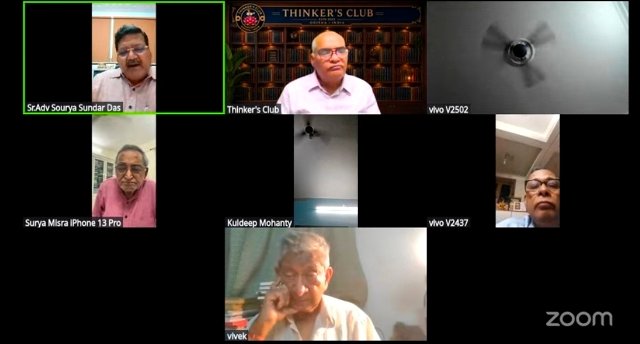
Cuttack/Odisha,Aug 11 : The Thinkers’ Club in its 159th webinar of the 6th year organised a discussion on the “Uniform Civil Code”. The meeting was presided by Sj Vivek Pattanaik, former senior bureaucrat. The meeting is moderated by Sj Barada Prasanna Das, President of the Club. Dr Nanda Nandan Das, former Secretary of Works Department was the observer. Surjya Narayan Mishra, Retired Professor of Political Science, Utkal University was the Chief Speaker. Sr Advocate of Odisha High Court, Sourjya Sunder Das was another important speaker. Many intellectuals and interested people participated in the webinar.
Professor Mishra highlighted on the history of Personal Laws in the country. According to him, when the Britishers were ruling, had not touched certain aspects of the personal law of different religions. They allowed major laws equal for all religions. For example, the Contract Act, Indian Penal Code are same for everybody. Law relating to marriage, divorce, adoption, inheritance and maintenance are different for different religions.
India is a multi-cultural, religion country of diverse ethnic groups. Before arrival of the Britishers, that is in the year 1605, Muslims were there. Some of them were invaders and some turned to be rulers. In spite of that, there was no communal disharmony. Aurungzeb, imposed Jijia tax but there were no communal conflicts in this country. Britishers received a writing from the Moghul Badshah, Jahangir to trade here for 500 years. Of course, this document is not seen by other Indians. They brought Christianity, their culture, education system, administration process to affect the Indian life to a greater extent. They adopted a principle of “Divide and Rule.” They inquinated the relationship between the two communities in a phased manner. The examples are many. To give a simple example, the language of the courts was Parsi at that time. Warren Hastings introduced the English language in the year 1835 in this country. The Hindus readily accepted the language. The orthodox Muslims, restrained themselves from learning the language. The result was thousands of Muslims lost their job and were replaced by the Hindus. The law of the country was broadly divided in to 2 parts. 1 is the Criminal Law, 2. The civil law. The Britishers made the criminal law uniform for all citizens. The IPC, Crpc were being followed by us since 1862 and 1861 respectively. They also unified a major portion of the Civil laws of common interest. The Contract Act, The Partnership Act etc were common to all religions. Due to political reasons, they have not touched the personal laws, which basically relates to 5 things. 1. Marriage, 2. Divorce, 3. Maintenance, 4. Succession, 5. Adoption. The Muslims were allowed to follow the Shariat laws. The Shariat law is a vague concept. The Muslims say, it is as per the holy book Koran. But none of the scholars are able to locate such laws in the holy book. After Independence, the new Government headed by Nehru took no steps to rationalise the personal laws. Though our constitution gives independence to the citizens in the matter of religion and faith, it stipulated under Article 44, to have same rule and law for all citizens. In subsequent years the bill was placed in the Parliament twice in the years 2019 and 2020 but withdrawn for some reasons. At present 5 states in the country have passed the UCC bill in their respective Assemblies. There is no flutter in those states after passing of the Bill.
Senior Advocate S.S.Das said, the bifurcation of the Hindu code during the tenure of Nehru was not in the interest of the nation. It was modulated with the vote bank policy and appeasing the Muslims. In 1985, the Sahabano case focused on the plight of the suffering Muslim women. It was a pity that, in spite of the progress in the human knowledge, these unfortunate women had no legal rights. They were under the mercy of men. Divorce for Muslims was very easy. Uttering 3 times orally, Talaq to the wife completes divorce. There was no provision of maintenance under the Shariat law for these unfortunate women. The Supreme court, permitted maintenance under the CRPC.
The intellectuals feel the necessity of a common law in the country irrespective of their religious believes. The UCC is not meant to destroy any religious faith or procedures. It only focuses on 5 pivotal points. Marriage under UCC demands registration. It prohibits polygamy. It also recognises “Live in Relationship” The live in Relationship is another form of marriage with no differentiation. The law does not prescribe manners of marriage. After introduction of UCC, the Christians will marry in a Church, Muslims in a Mosque and the Hindus in their traditional way. Law is not restricting on usual customs and traditions.
Divorce under UCC, can not be oral. It is to be under proper procedure and systems. It is also to be recorded by suitable authorities.
Maintenance. After divorce, based upon merit of the issue due compensation is to be provided to the aggrieved or weaker party.
Succession. Succession is different in different communities. Earlier, when person changed his religion, he was considered as a civil dead person. He lost all rights from his property. This was restored by the Britishers. Under the Hindu Code, there are mainly two schools of application. Mitrakhyar and Dayabhaga. Muslims and Christians differed in succession. A common acceptable principle is to be adopted. Legal history shows, there are number of issues relating to succession. The HUF concept is not open to the two other major communities.
Adoption. Couples not having their biological successors may adopt children of others or from orphanage. There is a necessity of stable and clearcut legal sanction in this respect. UCC can provide a clear-cut path on this.
It is observed that, the Hindus may not have any problem on introduction of UCC. There is no discussion on the status of HUF after introduction of UCC. The authorities have to think over it from the angle of taxation. The Muslims may object to it. The Government has to convince them. The poor Muslims are not opposed to the introduction of UCC. From a practical point of view, the poor do not go for polygamy. Marriage is not a plaything for the poor. Unfortunately, these people do not have any voice in the law-making process. The intellectuals opinioned that, when Article 370 could be abolished by the present Government, it can safely devise means to pass UCC. Already, Uttarakhanda, Gujrat, Aasam and Madhya Pradesh have passed the Act. Goa is already enjoying UCC under the Portuguese laws. Present Government of West Bengle has announced introduction of UCC, very soon. Maharasta and Rajasthan are in the Pipe Line. It is strange to note that, the present government of Odisha has not initiated steps in this direction.
Engineer Nanda Nandan Das, welcomed UCC and hoped this will be leading the country to promote harmony among different communities and ultimately lead to peace and prosperity to the Country.
Sj Vivek Pattanaik, in his presidential speech said that, UCC is favoured in the Aticle 44 of the Constitution. Earlier it was in the list of fundamental Rights. Due to political state of the country at that time it was shifted to Part-IV of the Constitution which covers the Directive Principles. For good, this should be shifted to the original position.
Prof Umasankar Misra, participating in the discussion said, the UCC issue is making a bridge among different religions but the Constitution has not defined, what is religion anywhere in its pages. There is reference to law at different places. There is also no precedent where religion is defined. The courts, have avoided the issue, where ever such necessity arose.
Ambica Ballav Swain, Ashok Kumar Behera, Bibhudutta Mohanty, Dilip Choudhury, Kuldeep Mohanty, Advocate, S.R.Mohapatra and many intellectuals participated in the meeting and discussion. Bibhudutta Mohanty from Bangalore managed the technical affaires with utmost care.
The August body present in the meeting advised to send a memorandum to the chief Minister of Odisha and the Prime Minister considering the importance of the issue.
Thinkers’ Club arranges periodically webinars on topics of interest to the country and the citizens as a motto of its charter. It has planned to discuss on “Protection of the Environment on 23rd August. In the next meeting, there will be discussion on contemporary issues of present crisis and its prevention. The President and members of the Club, herewith make request to the elite members to participate in the webinars and present their views. They can also suggest topics that require discussion in the interest of the society.