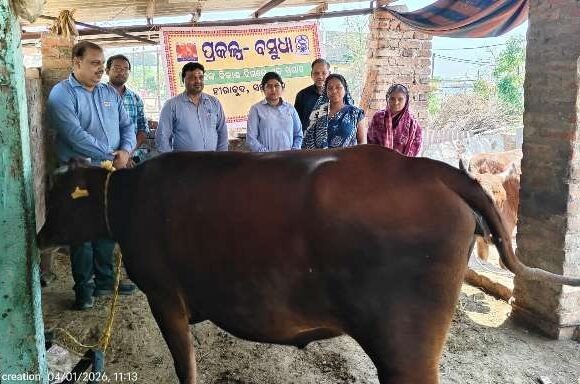

Making Odisha’s climate action plan work for women farmers
By Ranjana Das

Odisha’s State Action Plan on Climate Change (SAPCC), which guides climate action through 2030 in alignment with India’s national climate commitments, places this moment squarely at a mid-course point—when evidence from the ground should refine ongoing strategies. As climate-resilient agriculture gains prominence on global and national policy agendas, women are increasingly framed as agents of adaptation, and the SAPCC rightly acknowledges that women, tribal communities, and rainfed farmers face disproportionate climate risks. Yet in practice, climate action too often stops at training, without confronting the deeper gendered inequalities that shape who decides, who labours, who bears risk, and who ultimately benefits from adaptation efforts.
In districts like Mayurbhanj, climate change is not an abstract future threat. Women describe it through delayed monsoons, drying ponds by early summer, sudden cloudbursts that wash away seeds, and men migrating seasonally when farming no longer pays. Climate stress translates into longer workdays, thinner meals and greater responsibility for women—without corresponding authority over land, income or farming decisions.
Odisha’s vulnerability is well documented. Rainfed agriculture dominates, climate variability is increasing, and agriculture remains the backbone of rural livelihoods. Yet one under-acknowledged driver of vulnerability is the growing dependence on chemical fertilisers and pesticides. Across the state, agriculture has become increasingly input-intensive, driven by yield pressures and climate risk.
Evidence from a Community Need and Training Assessment conducted in Udali, Khadikasole and Budhikhamari villages in Mayurbhanj shows that over 90 per cent of households practice rainfed monocropping and 96 per centrely on chemical fertilisers. Women reported rising labour burdens linked to water scarcity, male migration and climate variability—shaping both adaptation priorities and constraints. These village-level patterns mirror state trends: Odisha’s fertiliser consumption reached nearly 9 lakh metric tonnes in Kharif 2023, around 6per centhigher than 2022, alongside rising pesticide use across cropping systems.
This is not merely a production issue. Chemical-intensive farming degrades soil health, weakens water retention and increases vulnerability to droughts and floods. Pesticide-heavy systems disrupt ecological balances and trap smallholders in cycles of rising costs and risk. Climate change and input-heavy agriculture reinforce each other—most acutely for small and marginal farmers.
Women stand at the centre of this contradiction. In tribal Odisha, they carry out most agricultural operations—sowing, transplanting, weeding, harvesting and seed storage. When men migrate in response to climate stress, women effectively become de facto farmers. Yet land ownership, access to credit and final decision-making largely remain with men. Women carry responsibility without authority.
This gap explains why many climate-resilience initiatives struggle to scale.
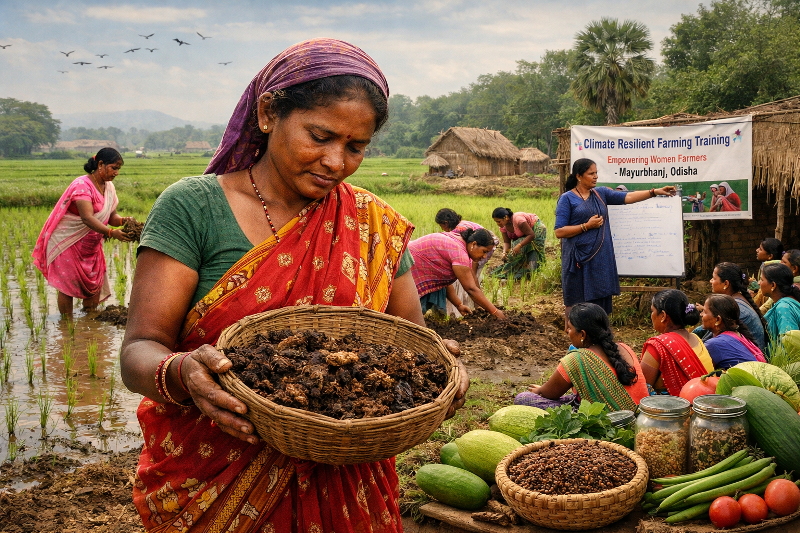
In Mayurbhanj, women clearly articulated demand for organic manure preparation, indigenous seed preservation and climate-resilient crops. Trainings on soil health, organic inputs and leadership were well attended. Women spoke confidently about millets, pulses and seed banks. On paper, this is what women-led adaptation looks like.
But adoption remained uneven—not due to lack of knowledge, but lack of decision-making power. Choices around crops, fertiliser use and financial risk continued to rest with husbands or elders. Agriculture remained a male decision-making domain, even as women supplied most of the labour.
There was another barrier rarely acknowledged in policy: labour. Organic and agroecological practices are labour-intensive, especially during transition phases. Composting, biomass collection and seed preservation add to women’s unpaid workload. In water-stressed villages, “low-cost” farming in financial terms often means high labour costs for women.
This is where Odisha’s climate action risks falling short. Training without power, and sustainability built on unpaid female labour, cannot deliver just resilience.
Making Odisha’s SAPCC More Gender-Responsive: Few Directions
First, embed gender-transformative approaches across climate programmes.
Climate-resilient agriculture initiatives under the SAPCC must go beyond targeting women as trainees. They should mandate the participation of men—husbands, elders and community leaders—in dialogues on shared decision-making, risk and labour distribution. Without engaging men, household power structures remain unchanged.
Second, strengthen women’s economic and land-related agency.
SAPCC-linked programmes should prioritise women-managed collectives—such as seed banks, producer groups and collective farming models—where income flows directly to women’s institutions and accounts. Strengthening women’s control over income enhances their bargaining power and enables adoption of climate-resilient practices.
Third, treat labour and water as core climate variables.
Organic and sustainable agriculture transitions must be paired with investments in water access, labour-saving tools and community infrastructure. Without reducing women’s time poverty, adaptation strategies risk becoming extractive rather than empowering.
Fourth, move women from beneficiaries to decision-makers.
The SAPCC’s emphasis on decentralised planning should translate into concrete support for women’s participation in Gram Sabhas, Panchayats and district-level climate planning forums—especially in tribal and high-vulnerability districts like Mayurbhanj.
Finally, measure what matters.
Monitoring frameworks under the SAPCC should track gendered outcomes, not just technical indicators. Decision-making roles, labour burdens, control over income and adoption costs must be treated as core indicators of climate resilience.
Odisha has shown leadership in recognising climate vulnerability and promoting sustainable agriculture. The next step is harder but unavoidable: confronting the gendered power structures that shape farming futures.
The women of Mayurbhanj are ready. They have articulated solutions, demanded knowledge and demonstrated leadership. If Odisha’s climate action is serious about resilience, it must move beyond training women to trusting them with power.
Only then will climate-resilient agriculture in Odisha be truly women-led—rather than quietly women-loaded.
————————-
(The article is based on a Project “Empowering Tribal Women Groups in Climate Resilient Farming Practices in Mayurbhanj district of Odisha; India” in Budhikhamari Panchayat of Mayurbhanj district; Ranjana Das is a Humphrey Hubert Fulbright Fellow and the project is supported by Humphrey Alumni Impact Grant by Institute of International Education (IIE) USA. The project is implemented in collaboration with Kartabya-Centre for Social Innovation a non-profit working on community resilience building in Odisha.)