
100-Day ‘Child Marriage–Free India’ Awareness Campaign Launched at District Level in Rayagada
BY SUDHANSU SINGH
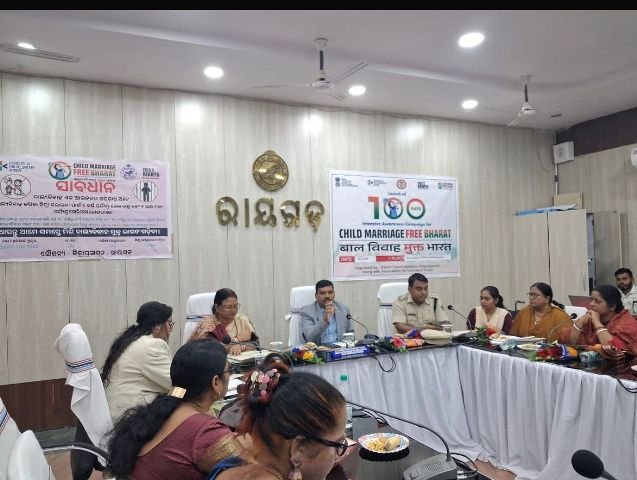
RAYAGADA/ODISHA,DEC 19 : The launch of the 100-day ‘Child Marriage–Free India’ awareness campaign at the district level in Rayagada marks a significant step in the district’s sustained fight against child marriage. Organised by the District Social Welfare Department at the Zilla Parishad Conference Hall, the initiative reflects a renewed administrative commitment to address the issue through awareness, prevention, protection and strict legal enforcement.
The campaign gains added importance in view of Rayagada district’s ongoing efforts to declare villages as child marriage–free. As per district data, 558 villages across 11 blocks have already been declared child marriage–free. Block-wise figures indicate that Bissamcuttack leads with 155 villages, followed by Rayagada block (91), Kolnara (82), Ramanguda (75), Kashipur (58), Kalyansinghpur (29), Chandpur (24), Padmapur (18), Muniguda (15), Gudari (10) and Gunupur (2). While these declarations reflect encouraging progress, officials underlined that sustained vigilance is essential to prevent the re-emergence of the practice.
Addressing the programme, speakers reiterated the three-pronged strategy of Prevention, Protection and Prosecution, stressing that awareness generation, timely rescue and rehabilitation of at-risk children, and strict legal action against violators must proceed simultaneously. The relevance of the Special Marriage Act, 1954, as a progressive and lawful alternative for voluntary and pressure-free marriages was also highlighted.
Adding to the discussion, Heena Rani, a NGO representative , said the main objective of the campaign is to spread awareness about the legal framework governing child marriage, its social and health consequences, and the critical importance of education and empowerment of girls. She emphasised that timely and targeted action would be taken through the identification of child marriage–prone areas, continuous monitoring of vulnerable children, and strong inter-departmental coordination to ensure effective prevention.
The programme also placed Rayagada’s efforts within the broader state context. According to the National Family Health Survey, Odisha has shown gradual improvement, with child marriage among girls declining from 21.3 per cent in NFHS-4 (2015–16) to 20.5 per cent in NFHS-5 (2019–21). However, district-level disparities persist, and Rayagada, with a prevalence rate of 33.2 per cent, remains among the districts with higher incidence, underscoring the need for focused district-level interventions.
Health officials highlighted that child marriage is a serious public health concern, closely linked to early pregnancy, increased maternal health risks and higher infant mortality. The emphasis on the PCPNDT Act further connected the campaign to the broader goal of gender equity and the prevention of discrimination against the girl child.
Officials from Women and Child Development, Health, Education, Police, Mission Shakti, ICDS, ST & SC Development departments, along with representatives of civil society organisations, participated in the programme and expressed collective commitment to taking the campaign forward across all blocks and gram panchayats.
The programme concluded with a collective pledge to work towards creating a ‘Child Marriage–Free Rayagada’ and contributing to the national objective of a ‘Child Marriage–Free India’.