
Top Mexican drug cartel boss ‘El Mencho’ killed by Army; violence erupts in several states
GUADALAJARA/MEXICO,FEB 23 : The Mexican army announced Sunday that it had killed powerful drug lord Nemesio “El Mencho” Oseguera in an operation that sparked a wave of violence in various parts of the country.
Oseguera, the 59-year-old leader of the Jalisco New Generation Cartel, was wounded in a clash with soldiers in the town of Tapalpa, in Jalisco state, and died while being flown to Mexico City, the army said in a statement. He had a $15 million US bounty on his head.
Gunmen retaliating for the raid blocked more than 20 roads in western Jalisco state, which includes Tapalpa, with burning cars and trucks. The violence spread to other states as well.
Oseguera, whose nickname was “El Mencho,” is one of the biggest Mexican drug lords to be taken down since the capture of the founders of the Sinaloa cartel, Joaquin “El Chapo” Guzman and Ismael Zambada. Both are now serving time in the United States.
Sunday’s statement said that in addition to Mexico’s own military intelligence, the raid was carried out with “complementary information” from US authorities.
It said six suspected cartel gunmen besides Oseguera were killed and three soldiers were wounded.
Two cartel suspects were arrested and a variety of weapons were seized, including rocket launchers capable of taking down airplanes and destroying armored vehicles, the statement said.
As gunmen blocked roads with retaliatory violence, Jalisco state, which is scheduled to host four World Cup games this summer, cancelled all events involving large crowds on Sunday and in-person classes on Monday.
Great development for Mexico
The streets of the state capital Guadalajara were almost empty as stores, pharmacies and gas stations shut down.
Maria Medina, who works in a gas station that was set on fire, said men with guns showed up and told everyone to get out.
“I thought they were going to kidnap us. I ran to a taco stand to take cover with the people there,” Medina told AFP.
The violence spread to the neighboring state of Michoacan, where Oseguera’s cartel also has a presence, and to the resort city of Puerto Vallarta.
His cartel was formed in 2009 and became one of Mexico’s most violent drug trafficking organizations, according to the US Justice Department.
The United States has classified the Jalisco cartel as a terrorist organization and accuses it of sending cocaine, heroin, methamphetamine and fentanyl into the United States.
US Deputy Secretary of State Christopher Landau welcomed the operation and called Oseguera “one of the bloodiest and most ruthless drug kingpins.”
“This is a great development for Mexico, the US, Latin America, and the world,” he added.
White House Press Secretary Karoline Leavitt said via X that the U.S. government provided intelligence support for the operation. “‘El Mencho’ was a top target for the Mexican and United States government as one of the top traffickers of fentanyl into our homeland,” she wrote. She commended Mexico’s military for its work.
“Ever since President (Claudia) Sheinbaum has been in power, the army has been way more confrontational, combative against criminal groups in Mexico,” said David Mora, analyst for International Crisis Group in Mexico. “This is signaling to the U.S. that if we keep cooperating, sharing intelligence, Mexico can do it, we don’t need U.S. troops on Mexican soil.”
The raid came amid pressure from US President Donald Trump for Mexico to stem the flow of drugs, particularly fentanyl, into the United States.
Trump has threatened repeatedly to slap tariffs on Mexican exports, arguing that Sheinbaum has not done enough to combat the drug trade.
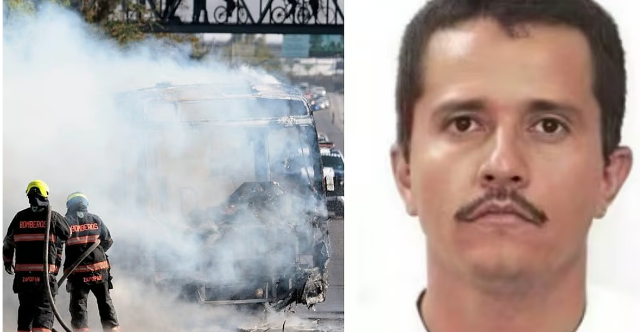
Firefighters extinguish a burning bus set on fire by organised crime groups in response to an operation in Jalisco to arrest a high-priority security target, at one of the main avenues in Zapopan, state of Jalisco, Mexico, on February 22, 2026.
US, Canada issue travel warnings for Mexico after drug kingpin killing
The killing of the drug lord set off several hours of roadblocks with burning vehicles, tactics commonly used by the cartels to block military operations.
Mexican President Claudia Sheinbaum urged citizens to remain calm and said the central government was in coordination with state authorities.
Videos circulating on social media showed smoke billowing over the tourist city of Puerto Vallarta in Jalisco, and people sprinting through the airport of the state’s capital in panic.
Air Canada announced it was suspending flights to Puerto Vallarta “due to an ongoing security situation” and advised customers not to go to their airport. A number of Mexican and international airlines also canceled flights.
A police officer stands guard by a charred vehicle after it was set on fire, on a road in Guadalajara, Jalisco state, Mexico, Sunday, Feb. 22, 2026, after the death of the leader of the Jalisco New Generation Cartel, Nemesio Rubén Oseguera Cervantes, known as “El Mencho.”
A police officer stands guard by a charred vehicle after it was set on fire, on a road in Guadalajara, Jalisco state, Mexico, Sunday, Feb. 22, 2026, after the death of the leader of the Jalisco New Generation Cartel, Nemesio Rubén Oseguera Cervantes, known as “El Mencho.”Photo |AP
In Guadalajara, burning vehicles blocked roads and businesses shuttered just months before Mexico’s second-largest city is scheduled to host matches during this summer’s soccer World Cup.
The U.S. State Department warned U.S. citizens in Jalisco, Tamaulipas, Michoacan, Guerrero and Nuevo Leon states to remain in safe places due to the security operations. Canada’s embassy in Mexico warned its citizens in Puerto Vallarta to shelter in place and generally to keep a low profile in Jalisco.
Jalisco Gov. Pablo Lemus told residents to stay at home, suspended public transportation and said that the state was “living through critical hours.”
The Jalisco cartel has been one of the most aggressive cartels in its attacks on the military — including on helicopters — and is a pioneer in launching explosives from drones and installing mines. In 2020, it carried out a spectacular assassination attempt with grenades and high-powered rifles in the heart of Mexico City against the then head of the capital’s police force and now federal security secretary.
The DEA considers the cartel to be as powerful as the Sinaloa cartel, one of Mexico’s most infamous criminal groups, with a presence in all 50 U.S. states. It is one of the main suppliers of cocaine to the U.S. market and, like the Sinaloa cartel, earns billions from the production of fentanyl and methamphetamines. Sinaloa, however, has been weakened by infighting after the loss of its leaders Ismael “El Mayo” Zambada and Joaquín “El Chapo” Guzmán, both in U.S. custody.
Oseguera Cervantes, 59, was originally from Aguililla in the neighboring state of Michoacan. He had been significantly involved in drug trafficking activities since the 1990s. When he was younger, he migrated to the U.S. where he was convicted of conspiracy to distribute heroin in the U.S. District Court for the Northern District of California in 1994 and served nearly three years in prison.
Following his release from custody, Oseguera Cervantes returned to Mexico and reengaged in drug trafficking activity with drug lord Ignacio Coronel Villarreal, alias “Nacho Coronel.” After Villarreal’s death, Oseguera Cervantes and Erik Valencia Salazar, alias “El 85,” created the Jalisco New Generation Cartel around 2007.
Initially, they worked for the Sinaloa Cartel, but eventually split and for years the two cartels have battled for territory across Mexico.
-AFP