

Geeta Jayanti Mahotsav Highlights the Gita’s Timeless Message of Balance and Inner Wellbeing
By Baisali Mohanty
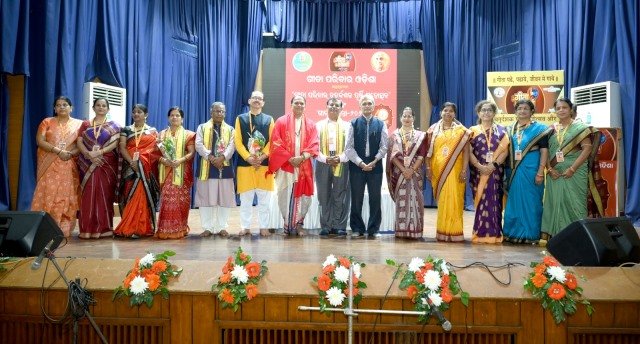
Bhubaneswar, Dec. 2: The enduring relevance of the Shrimad Bhagavad Gita as a guide to holistic living was the focus of the Geeta Jayanti Mahotsav, which drew an engaged audience of scholars, professionals, and spiritual seekers here on Monday.
Eminent Sanskrit scholar Prof. Harekrishna Satapathy, former Vice-Chancellor of the Central Sanskrit University, Tirupati, attended as the chief guest, while distinguished paediatric surgeon and former AIIMS Bhubaneswar Director Dr. Ashok Kumar Mahapatra, a Padma Shri awardee, was the guest of honour.
Addressing the gathering, noted neurosurgeon and thinker Dr. Ashok Mohapatra stressed the Gita’s approach to integrated wellbeing, asserting that true health rests on harmony among mental, physical, social, and spiritual dimensions. “Spiritual health is as essential as physical fitness,” he said, adding that it deepens through sincere study and understanding of the Gita’s teachings.
Drawing on Gandhian philosophy, Dr. Mohapatra referenced Mahatma Gandhi’s ‘Nature Cure’ and ‘My Experiments with Truth,’ noting that both were profoundly influenced by the Gita’s emphasis on self-discipline, ethical conduct, and inner clarity. “In today’s pressure-filled world, the Gita continues to be a source of calmness, steadiness, and peace of mind,” he observed.
Prof. Satapathi offered a wider cultural and philosophical perspective, describing the “Geeta Pariwar” as a global family united by the teachings of Geeta Maa, transcending religious boundaries. He underlined that the Gita is not a sectarian scripture but a universal guide for humanity. “Its wisdom belongs to all,” he said.
Elaborating on key principles for balanced living drawn from the Gita, Prof. Satapathy spoke of Yukta Ahar—moderation in food and the spiritual practice of offering meals to the divine; Yukta Vihar—maintaining disciplined and moderate physical activity; and Yukta Chesta—right intention and purposeful action to achieve meaningful success. He emphasised that contentment arises from right action, while equilibrium between work, effort, and rest—yukta karma and yukta swapna—nurtures a stable and fulfilling life.
Concluding his address, Prof. Satapathy said the spiritual journey from vishad (despair) to prasad (inner fulfilment) forms the central message of the Bhagavad Gita, with the 18th chapter encapsulating this transformative vision.
The Mahotsav concluded with participants reaffirming the Gita’s status as a living philosophy that continues to guide generations towards peace, clarity, and purposeful living.