
AIIMS Bhubaneswar Doctors Remove 7-kg Giant Tumour from Woman’s Arm
By Swagatika Mohapatra
Bhubaneswar, June 6: Doctors from the Department of Burns and Plastic Surgery, AIIMS Bhubaneswar, have successfully treated a 47-year-old woman suffering from a giant Plexiform Neurofibroma of the left upper limb, a condition that had severely affected her life for nearly three decades.
The patient, a daily-wage labourer from Baripada in Mayurbhanj district, had been living with a massive hanging swelling extending from the middle of her arm to the back of her hand.
Over the years, the tumour progressively enlarged, becoming extremely heavy and causing significant disability. It severely restricted shoulder movement, compromised hand function, and made routine daily activities increasingly difficult. The overlying skin had also become darkened and ulcerated due to prolonged pressure.
Detailed pre-operative investigations revealed a highly vascular lesion measuring approximately 45 cm in length, making the surgery particularly challenging because of the substantial risk of bleeding.
Given the complexity of the case, the patient was managed in two stages. The first surgery involved removal of the forearm component of the tumour during a six-hour procedure. Following a six-month interval, the second surgery was performed to excise the hand component, which lasted approximately three hours.
Congratulating the medical team, AIIMS Bhubaneswar Executive Director Prof. (Dr.) Ashutosh Biswas, praised the successful execution of the complex surgery and said that the procedure has provided a new lease of life to the patient.
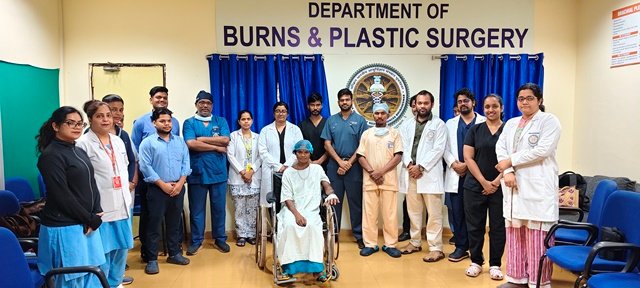
The surgical team from the Department of Burns and Plastic Surgery comprised Dr. Sanjay Kumar Giri, Dr. Syama Sundar Behera, Dr. Ahana Bandyopadhyay, Dr. Surya Yashaswi PVS, Dr. Keerthi G, Dr. Nikhil Kumar Sharma, and Dr. Asutosh Adhikari. Anaesthetic support was provided by Dr. Devishree Das and Dr. Pooja.
The team employed advanced vessel-sealing technology, LigaSure, along with meticulous surgical planning to effectively control intraoperative bleeding. Blood transfusion support was required during the procedures. The excised tumour tissue weighed approximately 7 kilograms.
Following tumour removal, the resultant raw areas were reconstructed using skin grafts harvested from usable skin available on the excised tissue itself. This innovative approach helped avoid creating additional wounds at donor sites elsewhere on the patient’s body. The grafts have shown excellent uptake, and the patient is recovering well under regular follow-up and dressing care.
The successful management of this rare and complex case underscores the importance of advanced surgical expertise, multidisciplinary teamwork, and comprehensive perioperative care in restoring function and significantly improving the quality of life of patients suffering from long-standing disabling conditions.