

From Gen Z to Gen Beta: Changing Generations, Changing Mindsets
By Mahendra Kumar Darjee
Times change, societies evolve, and with them change the way people think, live and define their values. Every generation grows up in a world shaped by circumstances different from those experienced by its predecessors. As a result, each new generation tends to look at life through a different lens.
The emergence of Gen Z and the arrival of Gen Beta are not merely about giving names to successive generations. They reflect a deeper transformation brought about by technology, changing family structures, new forms of education, evolving relationships and shifting social values.
Gen Z is generally considered to comprise those born between 1997 and 2012. They grew up alongside the internet, smartphones, social media and digital communication. For them, the digital world is not a technological revolution they witnessed; it is simply part of everyday life.
Gen Beta, generally referring to those born from 2025 onwards, will grow up in an environment that is likely to be even more deeply shaped by artificial intelligence, smart devices, automation and personalised digital technologies. But since this is an emerging generation, it would be premature to make definitive claims about its mindset or behaviour.
Gen Z: A generation that questions
One of the defining characteristics associated with Gen Z is its willingness to question established conventions. Things that earlier generations accepted in the name of tradition are increasingly being examined through the lens of reason, choice and individual freedom.
From education and careers to clothing, relationships and lifestyles, young people increasingly want to make decisions based on their own preferences and aspirations.
The conventional idea that a secure, traditional job should be the ultimate goal of life is also being challenged. Start-ups, freelancing, content creation, digital businesses and newer professions have opened up possibilities that previous generations could hardly have imagined.
Yet, this generation also faces its own set of pressures. An overwhelming number of choices, constant comparison with others on social media, the expectation of instant success and the pressure to remain visible and relevant can make life increasingly complicated.
It would therefore be simplistic to dismiss Gen Z merely as a “smartphone generation”. Behind its digital habits is a generation negotiating an unprecedentedly fast-changing world.
Gen Beta: Growing up with AI
If Gen Z grew up with the internet, Gen Beta is likely to grow up with artificial intelligence as an integral part of everyday life.
For a child belonging to Gen Beta, AI may not appear to be a futuristic technology. It could be as ordinary as a television, smartphone or computer is today. Education, entertainment, communication, healthcare and even household activities could increasingly involve intelligent systems.
This raises an important question: when children have access to increasingly sophisticated technology from an early age, what impact will it have on their imagination, creativity, independence and ability to empathise with others?
Technology itself cannot answer that question. The responsibility will rest equally with families, schools and society.
Giving a child a digital device may be easy. Sitting down with the child and having a meaningful conversation is harder. Providing access to online learning may be convenient, but teaching compassion, responsibility and respect requires human engagement.
More gadgets, fewer relationships?
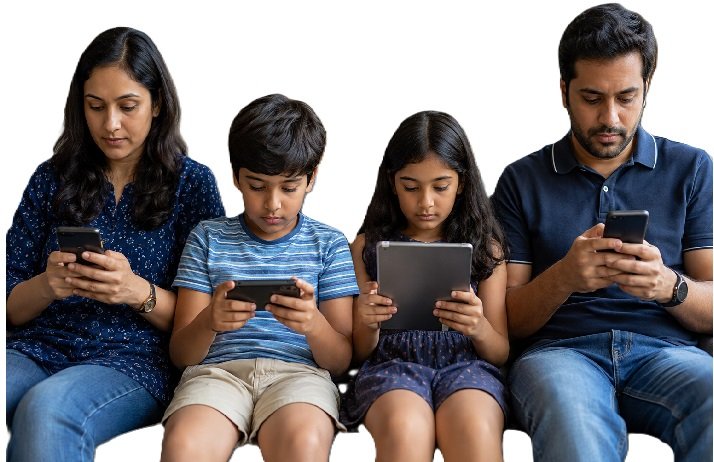
There is an irony at the heart of modern life. Four members of a family may sit together in the same room, yet each may be looking at a different screen.
Communication has never been easier, but meaningful conversation can sometimes feel increasingly difficult.
Technology has given us countless ways to connect, yet physical and emotional proximity do not necessarily guarantee genuine connection. The challenge before families is therefore not simply to control screen time, but to ensure that technology does not replace human interaction.
Differences between generations are nothing new. Every generation has disagreed with the one before it. What is different today is the speed of change. Technology, social norms and career patterns are evolving so rapidly that the gap between parents and children can sometimes appear wider than ever.
That gap cannot be bridged through criticism or blame. It requires patience, dialogue and mutual understanding.
Rethinking education
The education system of the future cannot remain confined to textbooks, classrooms and examinations.
AI can provide information, analyse data and assist in solving problems. But deciding what is right or wrong, ethical or unethical, responsible or irresponsible will remain a fundamentally human responsibility.
Future education must therefore place technology alongside critical thinking, creativity, empathy, ethical reasoning, social responsibility and human values.
The objective should not be to produce children who merely know how to use technology. It should be to produce individuals who know when, why and how technology should be used.
A warning for parents
Meeting every demand of a child is not necessarily the highest expression of parental love. Sometimes the greater expression of love is giving children time, listening to them, helping them understand their mistakes and allowing them to learn responsibility.
Before putting a smartphone in a child’s hands, it is perhaps more important to build a strong foundation of values in the child’s mind.
Technology is only a tool. How that tool is used will ultimately depend on the values, judgement and character of the person using it.
Generations may change. Values should not.
There is little merit in blaming Gen Z or fearing Gen Beta.
Every generation has its strengths and weaknesses. Technology will change. Careers will change. Educational methods will change. Lifestyles will change. But values such as truth, empathy, respect, responsibility, discipline and humanity should not become obsolete.
Today’s Gen Z will eventually become tomorrow’s parents. The children growing up as Gen Beta will one day shape society themselves.
The question we must ask today is not simply whether the next generation will be smarter. It is whether it will also be more humane.
A technologically advanced society without empathy would be an incomplete achievement. A highly connected world in which people struggle to form meaningful human relationships would represent a paradox of progress.
Generational change is inevitable. But the disappearance of humanity along with it would be a failure of society.
The responsibility to understand Gen Z and guide Gen Beta, therefore, does not rest solely with parents. It belongs to families, schools, policymakers, technology companies and society as a whole.
What we need is a generation that uses technology as a tool rather than becoming its servant; a generation that can live confidently in a digital world without losing the warmth of human relationships.
The real measure of progress will not be how intelligent our machines become, but how wisely and humanely we choose to use them.