
Rajendra University at 82: From a Maharaja’s Vision to a University for Western Odisha

Prof Bibhuti Bhushan Malik, Vice Chancellor, Rajendra University, Balangir, Odisha
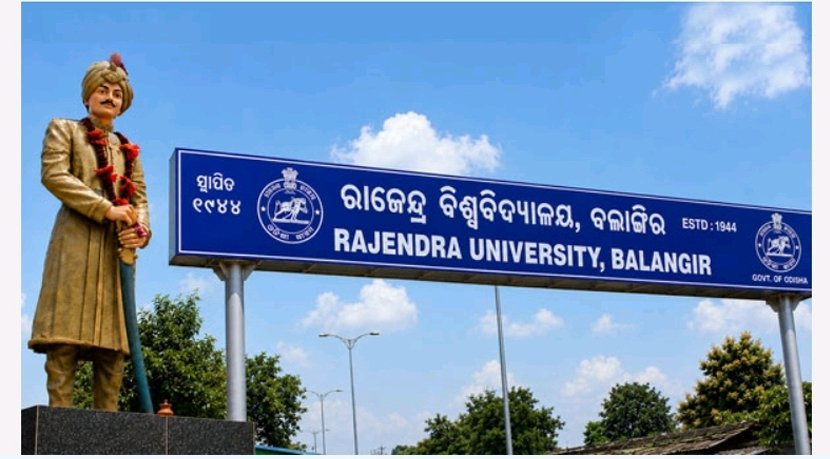
On its sixth Foundation Day, Rajendra University must look beyond celebration and renew its historic commitment to the educational transformation of Western Odisha. On September 1, 2026, Rajendra University, Balangir, celebrates its sixth Foundation Day as a university. Yet its history cannot be measured merely by these six years. The institution carries a much older legacy—one that began on July 3, 1944, when Maharaja Rajendra Narayan Singh Deo, the then ruler of the erstwhile Patna State, established Rajendra College. What we celebrate today, therefore, is not simply the sixth anniversary of a university but more than eight decades of an educational journey that has accompanied the social transformation of Western Odisha.
The story of Rajendra is, in many ways, the story of the region itself.
When the college was established in 1944, higher education was a distant aspiration for much of Western Odisha. The establishment of an institution of higher learning in Balangir was consequently not merely an educational initiative; it was an act of social vision. Rajendra Narayan Singh Deo understood that the progress of a region ultimately depended upon the creation of institutions capable of producing knowledge, leadership and human capital.
The institution began its journey as an Intermediate College. It was upgraded to a degree college in July 1946 with the introduction of the B.A. pass course. Its academic expansion continued steadily. Commerce became a full-fledged part of its degree education in 1964-65 and Science followed in 1965-66. Postgraduate teaching in Arts, Science and Commerce began in 1978-79. From January 1967, the college came under the affiliation of Sambalpur University. In 2002, another decisive milestone was reached when Rajendra College was granted autonomous status with effect from April 1.
Each of these transitions represented something larger than an administrative change. Intermediate education became undergraduate education; undergraduate education expanded into postgraduate learning; affiliation gradually gave way to academic autonomy; and autonomy ultimately prepared the institution for its transformation into a university.
That transformation came in 2020.
The Government of Odisha upgraded Rajendra Autonomous College into Rajendra University, with the university becoming operational as a state public university from September 1, 2020. Its territorial jurisdiction extends over the colleges of Balangir and Subarnapur districts. The creation of the university was an acknowledgement of the institution’s historical importance as well as the growing educational aspirations of the region.
The transition from college to university, however, was not merely a change of nomenclature. It imposed a much greater responsibility. A university is expected not only to transmit knowledge but also to create it; not merely to award degrees but to generate intellectual leadership; not simply to serve enrolled students but to respond to the developmental needs of its wider region.
Rajendra University has inherited an extraordinary intellectual legacy. Over the decades, its alumni have entered the civil services, judiciary, academia, politics, administration, business, professions and virtually every important sphere of public life. Teachers, professors, administrators, judges, political leaders and professionals who passed through the institution have contributed to Odisha and to the country. The alumni story of Rajendra is therefore also a story of social mobility: generations of young people from ordinary families found in this institution an avenue to education, employment, dignity and public service.
This is perhaps Rajendra’s greatest contribution.
The institution has historically served a region where geographical distance, economic disadvantage and social inequalities often restricted access to higher education. Its importance cannot therefore be judged only by conventional indicators such as buildings, courses or enrolment. Its deeper significance lies in the opportunities it has created for first-generation learners and students from rural and economically disadvantaged backgrounds.
The university’s geographical responsibility is equally significant. Its jurisdiction over Balangir and Subarnapur places it at the centre of the educational aspirations of Western Odisha. The region requires universities that understand its distinctive social, economic, cultural and ecological realities. Rajendra University can and must become such a university.
The institution already possesses substantial foundations for this transformation. Its campus, spread over about 60 acres, includes academic, administrative, science, commerce and newer academic facilities. Its library is among its important intellectual assets, while postgraduate education has expanded across Arts, Science and Commerce. The university’s stated vision is to develop itself as a centre of excellence with an ecosystem combining teaching, learning, research and socially responsible human-capital formation.
The next phase must therefore be about quality, relevance and regional responsibility.
The availability of modern digital infrastructure is an important beginning. The university has moved towards campus-wide high-speed connectivity, including a 1 Gbps fibre-optic network covering academic buildings, administrative facilities and hostels. Such infrastructure is no longer a luxury. In the age of digital education and artificial intelligence, connectivity is becoming an essential component of educational equity. A student from a remote village should be able to access the same digital knowledge resources as a student in Bhubaneswar, Delhi or Bengaluru.
The university is also entering an important phase of infrastructure development. Under PM-USHA, Rajendra University has received support for strengthening its infrastructure, with new hostel facilities among the planned interventions. The allocation of Rs 20 crore for the university reflects recognition of the institution’s role in the educational development of the region.
But bricks and mortar alone cannot create a great university.
The real transformation must take place in classrooms, laboratories, libraries and research centres. It must be visible in the quality of teaching, the confidence of students, the productivity of researchers and the relevance of academic programmes to the economy and society of Western Odisha.
Rajendra University must increasingly become a university of the region, by the region and for the region—without becoming intellectually confined to the region.
This requires stronger interdisciplinary research on tribal communities, migration, agriculture, water, environment, rural transformation, public health, education, culture, languages and local knowledge systems. Western Odisha offers enormous possibilities for research that can simultaneously be locally grounded and globally significant.
The university must also embrace the emerging knowledge economy. Artificial intelligence, data science, biotechnology, computational methods, digital humanities, entrepreneurship and skill-oriented education should become part of its academic imagination. Recent PM-USHA-supported national programmes on computational and data science and education indicate the direction in which the university is already moving.
Collaboration will be another critical pillar. The recent MoU between Rajendra University and IIT Bhubaneswar is particularly significant because it can open opportunities for advanced research, innovation, faculty development and student exposure to cutting-edge scientific knowledge.
The university should build similar bridges with institutions of excellence across India and abroad, while ensuring that collaboration ultimately benefits the student sitting in a Rajendra University classroom.
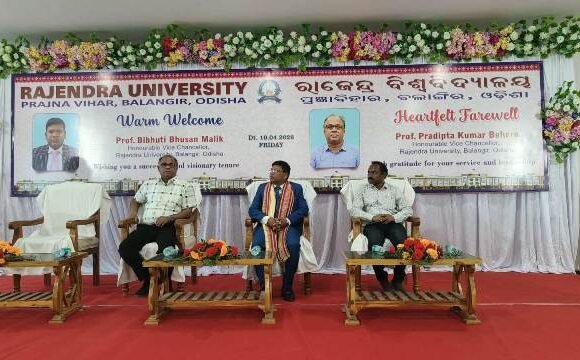
The institution’s journey has also been shaped by its academic leadership. Prof. Deepak Kumar Behera provided the initial leadership when Rajendra became a university. Prof. Uma Ballava Mohapatra assumed office as its first regular Vice-Chancellor in April 2021. Prof. Bibhuti Bhushan Malik subsequently took charge as the second Vice-Chancellor In April 2026, where in the university entered another phase with his appointment.
Different administrations may have different priorities and approaches, but the institution’s larger journey belongs to all of them—and, more importantly, to its teachers, employees, students and alumni.
As Rajendra University celebrates its sixth Foundation Day, it is appropriate to remember its founders and predecessors, but it is equally important to ask what future generations will inherit from us.
The founders gave the institution a vision.
The teachers gave it knowledge.
The students gave it energy.
The alumni gave it a reputation.
The university now has to give Western Odisha a new intellectual future.
The ambition should not be merely to become another state university. Rajendra should aspire to become a distinctive centre of excellence rooted in the history, culture and aspirations of Western Odisha while competing confidently with institutions anywhere in India.
Its motto, Aroha Tamasa Jyoti—an ascent from darkness towards light—offers an appropriate metaphor for this journey.
From an Intermediate College in 1944 to a degree college, from affiliation to autonomy, and from autonomy to university status, Rajendra has travelled a remarkable distance. The next journey must be from a historic institution to a transformative university.
That would be the most fitting tribute to Rajendra Narayan Singh Deo.
And that would make the sixth Foundation Day not merely a celebration of the past, but a declaration of responsibility towards the future.