
Beyond the Uniform: Dr Satyajit Naik and the New Face of People-Centric PolicinBeyond the Uniform: Dr Satyajit Naik and the New Face of People-Centric Policingg
By Akshya Rout
Jajpur/Odisha,Aug 29 : For Dr Satyajit Naik, IPS, more than 15 years in the Indian Police Service have meant a succession of demanding assignments—serving in Naxal-affected areas, handling law-and-order challenges in sensitive districts, working on national-security responsibilities and managing large-scale public events. Today, as Inspector General of Police, Central Range, Cuttack, he occupies a position at the centre of a wide range of law-and-order, public-safety and security responsibilities in Odisha. What stands out across these assignments is an approach that places emphasis on anticipation rather than reaction, technology without losing the human touch, and firm enforcement alongside community engagement. His career reflects an evolving understanding of policing: that maintaining public order is not only about responding to crime and disorder, but also about preventing conflict, managing risk and building public confidence.
From Veterinary Science to the IPS
Dr Naik’s journey into policing followed an unconventional path.
He earned a B.V.Sc. & A.H. degree from Odisha University of Agriculture and Technology and subsequently served in the Odisha Administrative Service before joining the Indian Police Service as a member of the 2008-batch Odisha cadre. He later completed a Master’s Degree in Police Management from Osmania University, Hyderabad, and the Advanced Management Program in Public Policy at the Indian School of Business, where he was recognised as a Scholar of Excellence and placed on the Dean’s List. The breadth of his academic and administrative experience has coincided with a period in which policing has become increasingly complex. Cybercrime, social-media misinformation, large public gatherings, natural disasters and organised criminal networks have expanded the demands placed on police organisations. Conventional law-enforcement methods alone are often insufficient to address these challenges.
Dr Naik’s assignments have provided experience across several of these areas.
Eastern Range: Emphasis on Prevention
His tenure as DIG, Eastern Range, covering Balasore and Bhadrak, was particularly significant in the context of preventive law and order management. Both districts include areas where communal sensitivities can turn relatively minor incidents into larger security challenges. Managing such situations requires sustained intelligence gathering, preventive action and engagement with local communities. During his tenure, security arrangements in sensitive areas, including Puruna Bazar in Bhadrak, were strengthened through coordinated deployment of Odisha Police and central forces, including the CRPF, BSF and RAF. CCTV surveillance and drone-based monitoring were used to enhance situational awareness, while social-media monitoring was strengthened to detect inflammatory content and rumours that could potentially disturb public order. Preventive action against habitual offenders, execution of pending non-bailable warrants and targeted measures against potential troublemakers formed part of the broader strategy. The underlying objective was to prevent incidents from escalating rather than relying solely on a rapid response after violence or disorder had occurred.
Managing Festival Security Through Force and Dialogue
The Shri Ram Navami celebrations and subsequent Sankirtan processions presented another test of the preventive policing model. Security deployments were planned in advance, including 26 platoons in Bhadrak and 17 platoons in Balasore, supported by intelligence assessments and security planning. At the same time, the policing strategy included flag marches, peace-committee meetings and engagement with local stakeholders. The approach sought to combine visible security with dialogue—ensuring that the police presence acted as a deterrent while creating channels through which concerns and grievances could be addressed.
The festival period passed without major communal disruption.
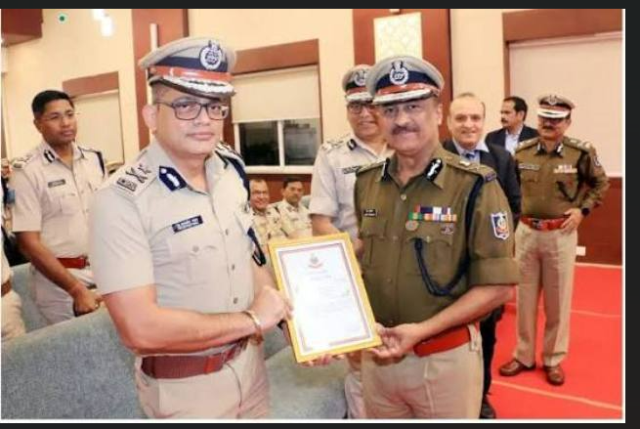
For his contribution to law and order and his handling of sensitive situations during his tenure in the Eastern Range, Dr Naik received the DGP’s Disc Award for 2024–25.
Rath Yatra 2026: Policing a Mega Congregation
The Puri Rath Yatra 2026 presented a different kind of challenge: managing an enormous congregation in which security, traffic, transportation, emergency response, public health and crowd management had to operate simultaneously. As IGP, Central Range, Dr Naik was involved in the security planning and implementation for the event. More than 220 platoons of security forces were deployed as part of a multi-layered arrangement. An eight-vertical security framework was put in place to address vulnerabilities across the Grand Road, Bada Danda, the Gundicha Temple area and other critical locations. The scale of the operation required close coordination among the police, health and fire services, temple authorities and servitors, railways, volunteers and other agencies. The challenge was not merely to deploy personnel but to ensure that multiple agencies functioned as part of a unified operational system.
Technology as a Force Multiplier
Technology formed a major component of the Rath Yatra security arrangements. An integrated command-and-control mechanism was linked to more than 470 high-definition CCTV cameras positioned at strategic locations. The system was intended to provide commanders with real-time information about crowd movement, congestion and traffic conditions, enabling operational decisions to be based on emerging situations. Sector-based policing and crowd-density monitoring were also incorporated into the arrangements. The approach reflects a wider shift in policing—from simply managing incidents to identifying and mitigating risks before they develop. The digital environment received similar attention. Dedicated teams monitored social-media platforms for rumours and misinformation, while verified traffic and security advisories were disseminated to the public. For modern policing, the objective of technology is not to replace personnel but to improve their ability to observe, assess and respond.
Putting the Citizen at the Centre
Large religious gatherings also highlight another dimension of policing: the need to protect individuals within the crowd. Pilgrims arrive with children, elderly family members and people with different physical and medical needs. Crowd management therefore has to go beyond controlling movement. During the Rath Yatra arrangements, attention was given to emergency evacuation corridors, ambulance routes and provisions for senior citizens, women, children and persons with disabilities. Police personnel were required to maintain security cordons and enforce restrictions while dealing with members of the public with sensitivity. Assistance to distressed pilgrims and the handling of missing children were also part of the wider public-safety effort, with volunteers, NCC personnel and civil-society groups contributing to the safety ecosystem. The emphasis was on combining security with service—a principle increasingly associated with people-centric policing.
Policing During Natural Disasters
Dr Naik’s responsibilities have also extended beyond conventional law and order.
During Cyclone Dana, he was involved in coordinating police deployment, inter-agency response and restoration efforts. One notable operation involved the night-time rescue of 30 families stranded in the Salandi river at Talagopabindhapur village in Tihidi, Bhadrak. Disaster situations test police leadership differently from conventional law-and-order operations. Roads may become inaccessible, communication networks may be disrupted and communities may need to be evacuated at short notice. In such circumstances, police leadership requires both decisiveness and adaptability, with the ability to coordinate resources while maintaining public confidence.