
Stone Sculptures Dating Back to the 7th–8th Centuries and Terracotta Sculpture from the 11th–12th Centuries Unearthed Again in Mantra-Famed Mayong, Assam
By Dalim Phukan
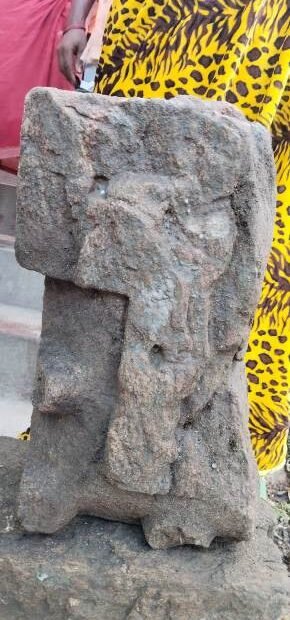
Assam, Aug 10 : The mysteries of Mayong, renowned as the land of Tantra and Mantra, seem to have no end! For hundreds of years, Mayong has been regarded across the world as a centre for the study and practice of mysterious and ancient knowledge systems such as Tantra and Mantra. On August 9, two unfinished stone sculptures believed to date back to around the 7th–8th centuries and an attractive terracotta sculpture belonging to the 12th–13th centuries were once again unearthed in Mayong.
These historical artefacts, which could provide clues to many unexplored aspects of the ancient human civilisation of Assam and the Northeast, were discovered at the “Kachshila Shiva Ashram” in Hatimuriyah village, one of the historically significant ancient Shaivite pilgrimage sites of Mayong.
According to details of the incident, Dr Utpal Nath, founder-secretary of the Mayong Rural Museum and Research Centre and a heritage-conscious professor at Mayong Regional College, along with Bipul Deka, another prominent member of the museum and a heritage-conscious cultural activist, happened to visit the historically significant Shiva Ashram situated on Kachshila Hill in Mayong, on the southern bank of the Brahmaputra.
The ancient Shiva Ashram is located on the summit of Kachshila Hill. A stretch of level ground lies some distance east of the main shrine of the ashram. The two heritage enthusiasts became curious after noticing that a portion of the soil in this area had been dug up.
On approaching the spot, they found numerous fragments of ancient broken bricks scattered across the area. They immediately contacted the priests of the ashram and enquired whether anything other than the broken brick fragments had been found while digging the soil.
The priests informed them that while the ground was being excavated to lay the foundation for a small building as part of the development of the ashram, they had discovered, besides fragments of small bricks, an attractive terracotta sculpture and two unfinished stone sculptures.
The two heritage enthusiasts immediately began examining the ancient artefacts. They found the terracotta sculpture at the main place of worship of the ashram, while the two stone sculptures were lying neglected at some distance from the shrine.
Considering that the preservation of these ancient sculptures was essential for the study of human history, they immediately took steps, with the cooperation of the ashram residents, to bring the artefacts to the Mayong Rural Museum and Research Centre for preservation.
According to Dr Utpal Nath, secretary of the museum, new historical artefacts have been discovered almost every year in different historical sites of Mayong in recent times. He reiterated that if the Archaeology Departments of the Government of India and the Government of Assam undertake scientific excavation in the Mayong region, there is a possibility of discovering many more archaeological remains.
He also expressed the view that these historical artefacts could help uncover many unexplored ancient mysteries not only of Mayong but also of Assam and India as a whole.
Dr Nath further informed that earlier too, several terracotta sculptures dating back approximately to the 12th–13th centuries had been recovered from the Shiva Ashram on Kachshila Hill in Mayong. Among the earlier discoveries was an attractive dancing human figure wearing a tortoise as a pendant.
These archaeological artefacts, now preserved at the Mayong Rural Museum and Research Centre, demonstrate that a highly advanced civilisation once flourished in the Mayong region.
It may be mentioned that the local people of Mayong have always been conscious of their heritage and have consistently made sincere efforts to preserve it with their own resources and without any expectation of personal gain.
However, the government has a large Archaeology Department with highly paid officials. It remains to be seen what initiatives the officials of the Archaeology Department undertake in the coming days to explore and preserve such historical artefacts of Mayong.