
Military and bureaucracy cannot function in silos, says Rajnath Singh
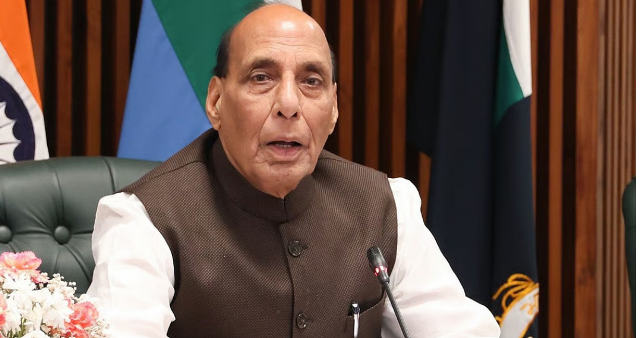
NEW DELHI, AUG 3 : Taking the government’s jointness agenda beyond the three armed forces, Defence Minister Rajnath Singh on Monday called for much closer integration between the military and civilian wings of the defence establishment, arguing that the two can no longer operate in silos if India is to build a defence ecosystem equipped for an era of hybrid, technology-driven warfare.
Addressing the AFHQ Civilian Services Day here, Singh said deeper institutional integration between the uniformed services and civilian officials was critical to creating genuine synergy, improving decision making and responding more effectively to rapidly evolving security and technological challenges. The interface between the military and the civilian bureaucracy has long been regarded as one of the weak links in India’s higher defence management.
To narrow that gap, the defence minister advocated structured cross-exposure through joint training programmes and developmental assignments, allowing officers from both sides to gain a better understanding of each other’s roles, expertise and institutional strengths.
“Military and administrative integration cannot advance on separate tracks,” he said, adding that as India moves towards joint and integrated military structures, closer coordination will be required across policy formulation, administration, human resource management, financial processes, logistics and institutional knowledge.
Further, emphasising that both military personnel and civilian officials are guided by the same “Nation First” commitment, Singh said their complementary strengths were essential for effective defence management.
“Military officers bring operational experience, command perspective and an understanding of warfare, while civilian officers contribute administrative continuity, policy expertise, knowledge of government processes and institutional memory. Together, these strengths lead to more informed, balanced and effective decision making,” he said.
The minister’s remarks come as the government presses ahead with reforms to India’s higher defence architecture, including the creation of the Chief of Defence Staff (CDS) and the Department of Military Affairs (DMA), while preparing to roll out integrated theatre commands (ITC). Defence planners have increasingly argued that operational integration alone cannot deliver its full benefits if planning, budgeting, procurement and administrative processes continue to function in separate civil and military silos.
Singh also urged the AFHQ Civilian Services to evolve beyond a purely administrative role and emerge as the “strategic brain” of India’s defence management architecture by developing deeper domain expertise and adapting to the changing character of warfare.
Observing that modern conflicts are increasingly shaped by technological disruption, he said the cadre should move beyond implementing service rules and contribute more directly to capability development. He suggested that the civilian brass could help develop defence-specific common cyber tools for the armed forces and proposed a dedicated forum to study Indian military history from a civilian perspective to generate fresh strategic insights.
“A military derives its strength not merely from weapons and ammunition, but also from the thousands of unseen hands that stand firmly behind it. AFHQ Civilian Services is one of those unseen yet decisive forces,” Singh said, adding that the cadre’s participation in core defence management was indispensable because of its institutional continuity and accumulated domain expertise.
-PTI