
Behind the spectacle of Rath Yatra: The massive operation that keeps Puri moving
By Sefalika Mohapatra
Puri, Aug. 2: When millions of devotees fill the Grand Road of Puri to catch a glimpse of the Holy Trinity on their majestic chariots, the world sees faith, tradition and devotion. But behind the spiritual spectacle lies a year-round administrative challenge—one of planning, precision and coordination on an extraordinary scale.
The annual Rath Yatra of Lord Jagannath is not merely a religious festival; it is a massive public management exercise involving millions of people, hundreds of agencies and thousands of personnel working together to ensure that the centuries-old tradition continues without disruption.
During the Srigundicha Yatra this year, over 15 million devotees converged on Puri, while an almost similar number participated in the Bahuda Yatra. The town witnessed another massive turnout during rituals like Suna Besha and Niladri Bije. Managing such an enormous congregation, comparable in scale and complexity to the country’s biggest religious gatherings, requires months of preparation.
For the Puri district administration, the festival begins long before the chariots move onto the Badadanda. Under the leadership of Collector Dibya Jyoti Parida, planning started in February with detailed consultations involving more than 25 government departments. From traffic flow and crowd control to sanitation, medical facilities, drinking water supply and emergency response, every possible challenge was mapped and addressed well in advance.
Regular reviews chaired by Chief Minister Mohan Charan Majhi, Chief Secretary Anu Garg, the Revenue Divisional Commissioner and senior government officials ensured that the arrangements remained aligned with ground realities.
“The grandeur of Rath Yatra is visible to everyone, but the effort behind it involves months of preparation and teamwork. Every ritual, every movement of devotees and every public service arrangement requires coordination and precision,” officials involved in the exercise said.
This year, the administration expanded its supervisory mechanism significantly. Twenty-three senior officers were appointed as Officers on Special Duty for focused monitoring, while 162 Executive Magistrates were deployed at critical points across Puri. A modern Integrated Command and Control Centre became the nerve centre of the operation, helping authorities track crowd movement, coordinate field teams and take quick decisions during emergencies.
The greatest uncertainty, however, came from the weather. Heavy monsoon showers before and during major rituals created additional challenges, with waterlogging affecting several areas of the town. But an extensive sanitation network helped maintain normalcy. Around 1,600 sanitation workers remained engaged throughout the festival, supported by 153 waste collection vehicles, 38 municipal pumps and additional fire service pumping systems.
The scale of cleanliness operations reflected the magnitude of the gathering. More than 2,500 tonnes of waste generated during the festival were removed, while over 1,400 temporary toilets and large parking zones continued to serve pilgrims despite difficult weather conditions.
Providing food and water to millions was another major logistical challenge. The administration supplied nearly 68 million litres of drinking water daily through kiosks, pipelines and tankers placed across the town. More than 730 authorised food distribution centres, supported by nearly 5,000 volunteers, provided free meals and drinking water to devotees.
Alongside public services, food safety remained a priority. Dedicated teams conducted over 1,300 inspections to ensure that food served during the festival met required hygiene standards.
Healthcare arrangements were designed keeping in mind the possibility of medical emergencies in a densely packed environment. The administration established 82 medical camps and 15 temporary hospitals, deploying 326 doctors, 222 nurses and a large team of paramedics and volunteers. Over 63,000 devotees received medical assistance during the festival.
For Collector Dibya Jyoti Parida, the successful completion of Rath Yatra was the result of collective dedication.
“An event of this magnitude can succeed only when every department, officer, employee and volunteer works with a shared sense of responsibility. The blessings of Lord Jagannath and the commitment of everyone involved helped us complete this massive task smoothly,” he said.
As the chariots returned to the Srimandir after the nine-day journey, Puri once again demonstrated a unique blend of tradition and modern governance. The festival may belong to faith, but its successful execution rests on planning, preparedness and precision.
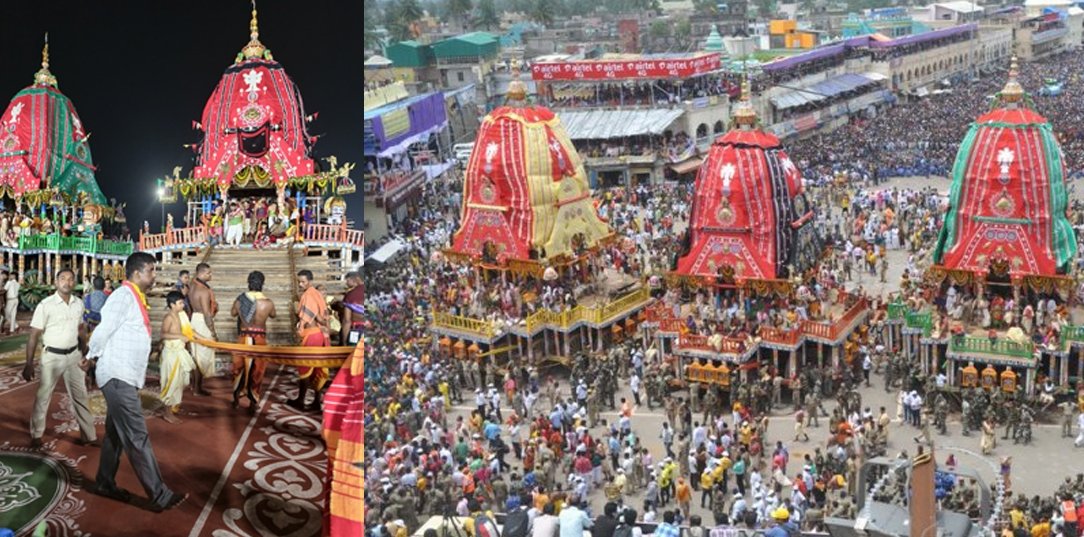
Photograph caption:
A behind-the-scenes glimpse of Rath Yatra preparations: Puri Collector Dibya Jyoti Parida supervises arrangements for the annual festival. The three chariots of Lord Jagannath, Lord Balabhadra and Devi Subhadra stand tall on the Badadanda (Grand Road) during the recently concluded nine-day celebration in Puri.