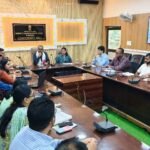

ABVP national executive council meeting in Bhubaneswar focuses on NEP, three-language policy

By Swagatika Mohapatra
Bhubaneswar, May 29: The three-day National Executive Council Meeting of the Akhil Bharatiya Vidyarthi Parishad (ABVP) which began at Siksha ‘O’ Anusandhan (SOA) University in Bhubaneswar on Thursday is focusing on National Education Policy (NEP) 2020, three-language police, education reforms, youth engagement, national security and linguistic diversity.
The meeting was inaugurated by ABVP national president Prof. Raghuraj Kishore Tiwari, national general secretary Dr. Virendra Singh Solanki and national organising secretary Ashish Chauhan through the ceremonial lighting of the lamp. Delegates from across the country were welcomed with traditional Odia musical performances featuring dhol and mridanga.
The annual national-level meeting is expected to deliberate on a range of issues, including implementation of the National Education Policy (NEP) 2020, student union elections, campus expansion, national security, socio-economic concerns and organisational strategies for the coming year.
Addressing the gathering, Prof. Tiwari said the meeting, being organised under the theme “Yuva Bharat Ka Aahvaan”, would review ABVP’s role in the prevailing educational and national landscape. He said discussions would focus on educational reforms, social priorities and future organisational plans, including initiatives linked to the centenary year of the Rashtriya Swayamsevak Sangh (RSS), the “Screen Time to Activity Time” campaign and the birth centenary celebrations of Prof. Yeshwantrao Kelkar.
A major highlight of the meeting was ABVP’s strong endorsement of the Three-Language Policy under the National Education Policy framework. Dr. Solanki described the policy as a significant step towards strengthening Indian languages, preserving linguistic diversity and promoting national integration.
“The Three-Language Policy should not be viewed through the narrow prism of linguistic elitism. It is an important instrument for educational empowerment and national unity,” he said.
He added that increasing inter-state mobility for higher education and employment makes multilingual learning beneficial for students across the country. Solanki also welcomed the Central Board of Secondary Education’s efforts to facilitate the policy’s implementation, including measures to address shortages of teachers and textbooks during the transition phase.
The meeting is also expected to discuss issues such as women’s safety, Urban Naxalism, service activities, environmental concerns, technology, international student outreach and preparations for the ABVP National Conference 2026.
Resolutions on education, national security and contemporary socio-political challenges are likely to be adopted during the three-day deliberations.