

India pumps 5,000 tonne of diesel into Bangladesh amid Iran war strain
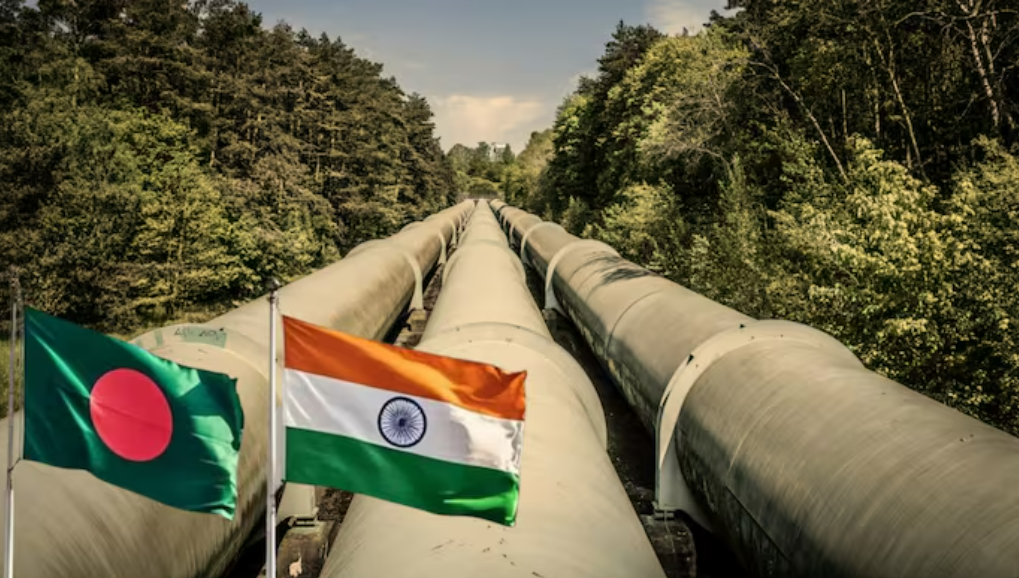
NEW DELHI, MAR 10 : Amid the raging war in West Asia, which has threatened global energy security, India has begun pumping diesel to Bangladesh through a cross-border pipeline from Assam’s Numaligarh refinery. At least 5,000 tonnes of diesel would reach Bangladesh on Tuesday as part of the supply, said Chairman of Bangladesh Petroleum Corporation (BPC), Muhammad Rezanur Rahman.
The move comes as Bangladesh faces a severe fuel shortage triggered by disruptions in global oil supplies due to the ongoing US-Israel-Iran war. The first shipment on Tuesday was part of a larger annual supply agreement between the two neighbours.
Sources in the BPC told Dhaka-based The Financial Express that the diesel consignment is expected to reach the Parbatipur depot in northern Bangladesh’s Dinajpur from the Numaligarh refinery in Assam through the Bangladesh-India Friendship Pipeline. The Bangladesh-India Friendship Pipeline, inaugurated in March 2023 by Prime Minister Narendra Modi and his Bangladeshi counterpart Sheikh Hasina, transports diesel from Numaligarh to the Parbatipur depot in northern Bangladesh’s Dinajpur district.
Bangladeshi officials say the delivery could ease immediate pressure on power generation and transport.
Bangladesh’s energy dependence on India has been under strain since the collapse of Sheikh Hasina’s government in August 2024. The interim administration of Muhammad Yunus that followed reviewed and partially suspended several power and energy agreements with New Delhi, alleging unfavourable terms.
Imports of electricity from Adani’s Jharkhand power plant were reduced, coal supplies were disrupted, and some cross-border gas and LNG initiatives slowed down. Against this tense backdrop, India’s latest diesel supply could be seen as a sign of bilateral energy ties stabilising again.
HOW MUCH DIESEL IS INDIA SENDING TO BANGLADESH AND HOW?
India has begun by sending 5,000 tonnes of diesel to Bangladesh via the India-Bangladesh Friendship Pipeline. Before the pipeline was inaugurated, fuel transfer had to rely on railway tankers.
The shipment is the first instalment under a broader agreement, where India has committed to supply 180,000 tonnes of diesel annually.
“We have an agreement with India, and according to that agreement, India will supply 180,000 tons of diesel to Bangladesh via the pipeline each year. The 5,000 tons of diesel that is arriving now is a part of that agreement,” Chairman of BPC, Muhammad Rezanur Rahman told news agency ANI.
He added that at least 90,000 tonnes would be delivered in the next six months to help Bangladesh deal with immediate shortages. Muhammad Rezanur Rahman said the shipments are part of a structured import plan aimed at stabilising fuel availability.
“…We hope that within the next two months, we will bring in the total diesel amount for the entire six months,” added the BPC chairman.
The transnational pipeline has become a strategic asset for both India and Bangladesh as it cuts transportation costs and delivery time compared to tanker shipments.
“The pumping started at 3.20 pm on Monday. It takes about 44 hours to bring in about 5,000 metric tonnes of diesel… We are pumping about 113 tonnes of oil here every hour. Accordingly, the supply is expected to be completed by tomorrow [Wednesday] evening,” the GM of the Commerce and Operations Department at BPC, Muhammad Morshed Hossain Azad, told The Financial Express.
WHY IS BANGLADESH FACING A FUEL CRISIS?
Like many other energy-dependent countries, Bangladesh’s fuel crisis has deepened because of the ongoing US-Israel-Iran war. The choking of the strategic Strait of Hormuz in the Persian Gulf has disrupted global oil flows. The Strait of Hormuz is one of the world’s most critical energy corridors.
Bangladesh imports around 95% of its fuel, much of it from the Middle East. Any disruption in supply routes quickly translates into shortages at home.
The crisis has already triggered long queues at petrol stations, rationing of fuel sales, and public anxiety. The Bangladesh government, in some places, has capped sales at 10 litres of petrol for motorcycles and 40 litres for cars.
ENERGY DEALS BETWEEN INDIA AND BANGLADESH CAME UNDER STRAIN AFTER HASINA’S EXIT
Energy cooperation between India and Bangladesh weakened after Sheikh Hasina’s government collapsed in August 2024 following mass protests. The interim administration launched a review of several major energy deals with India.
One of the agreements, which triggered a big row, was to import 1,320 MW of coal-fired electricity from Adani’s power plant in Jharkhand. Critics in Bangladesh argued the deal forced Dhaka to pay higher prices.
In November 2024, Adani halved power supply to Bangladesh over $850 million in unpaid dues. Later in March 2025, it resumed full power supply after Bangladesh began clearing dues.
Other cross-border energy initiatives, including renewable power cooperation and LNG projects, also slowed during the period of political uncertainty.
Now, India’s decision to continue fuel supplies despite tensions is being viewed as a sign of stabilisation in ties, which took a positive turn after the exit of the Yunus regime and the coming to power of Tarique Rahman’s BNP government in Dhaka. For Bangladesh, India remains the closest and most reliable energy partner because of geography and existing infrastructure. With the recent agreement, this is the reality both sides acknowledge and are working on after a turbulent period.
-PTI